• Wind: SW / 7-8 Bft
    • Weather: Rain / 20.4 °C
    • Water temperature: Water: 21.0 °C

    The new report “Under Way” is finished: I describe the onward journey of our rig without having any particular destination in mind. We decide spontaneously and according to whichever situation restricts our freedom the least, so that control over our own health stays in our hands. In this report I have taken explicit care that not a syllable is written about “C”, because a great many people have told me that they can no longer read or hear about it. Plenty of fine photos with text will certainly take your mind off things and perhaps draw you into a new spell of pleasure. I may also point out that this entry closes the logbook “Heat Instead of Ice”. I had in any case stopped making entries some months ago. Now I would like to describe our three-year southern tour in a few sentences, since people are used to getting some sort of conclusion from me after an expedition or a voyage like this. One sentence comes to mind straight away. “You have to pay for the sun.” Readers of the website will not quite understand it, since they are a little behind the report subscribers when it comes to information. It was a wonderful voyage that we would not want to have missed. It was more like a holiday, and yet there were quite a few ups and downs that we did not know from the northern voyages. In the north, as far as the middle of France, they were rather trivial little things to do with people’s mentality. Although I should say that the easy-going, carefree attitude appealed to me a great deal compared with the familiar German mentality. The further south we pushed, however, the more prickly the behaviour of the inhabitants became. People tried to take the law into their own hands and to confront you with it. The authorities, too, tried to apply the law very precisely, even though there was no reason at all for it. It was not only us who noticed this, but also others who really only wanted to live quietly. On top of that came the peculiar attitude towards medical care, which one often had to put down to a plain lack of willingness in the profession. My wife and I unfortunately had only very bad experiences with the health system. For a well-off European country, a fair number of doctors or hospitals sometimes had to be contacted before there was any treatment at all. Hundreds of kilometres had to be covered on the road to reach the doctor or hospital that was willing. That prices in the south are higher than in the north of France was known beforehand, but that the differences are so horrendous knocked even dyed-in-the-wool French people off their chairs. The situation got extremely worse after the first lockdown in 2020. From then on the checks and fines for every conceivable situation became unbearable. If the whole situation really were to change again, France would simply be a dream, especially for those boaters who want things a bit quieter and have the time. Finally I may add that for such an apparently easy voyage the ship in question should be adapted. No great measures are needed, but there is quite a bit one could do, not only for safety but also to limit damage to the ship. As you will certainly know, through the repair service I run down there I can also give helpful information from a distance by email harald-paul@haraldpaul.com or by telephone 0049151 / 15 84 33 37. Just ask and have a quote made. I am sure the advantage is on your side if you can save yourself the cost of repairs and damage. A short note for all new readers of our website: the “Paul’s Reports” are extended information on various subjects, researched by me personally on the spot, which I describe with plenty of photos and text. This report is already number 29 and is comparable to a chapter from a book. All the reports complement one another and make up a wide range of information with an unusually large number of photos, so that it is easier to picture yourself there. Anyone interested can find out under the heading Sales on this site how quickly and easily you can obtain such a report. Happy reading.
    • Wind: NE / 4-5 Bft
    • Weather: dark / 2.4 °C
    • Water temperature: Water: 8.0 °C

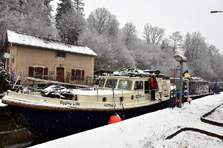
    The new report “Canal du Midi” is finished: it describes the entry into the world-famous canal in the south of France. Many of you will know it from a boating holiday on it. But as a holidaymaker you see much of it through different glasses in that short time. I report on a stay of several months in this canal, with all its ups and downs, which do not only concern the water level. Especially for boat owners who would like to spend a winter there, it is extended information of a kind you will not find in any cruising guide. All in all, another chapter from our voyage “Heat Instead of Ice”. A short note for all new readers of our website: the “Paul’s Reports” are extended information on various subjects, researched by me personally on the spot, which I describe with plenty of photos and text. This report is already number 28 and is comparable to a chapter from a book. All the reports complement one another and make up a wide range of information with an unusually large number of photos, so that it is easier to picture yourself there. Anyone interested can find out under the heading Sales on this site how quickly and easily you can obtain such a report. Happy reading.
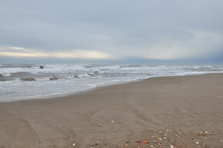
    • Position: 43° 16.859´ N 002° 55.017´ E
    • Wind: W / 3-4 Bft
    • Weather: dark / 28.6 °C
    • Water temperature: Water: 26.0 °C

    End of the logbook “Heat Instead of Ice”. Unfortunately, in the circumstances I have to suspend the logbook for an indefinite period. Our journey has been severely restricted by the steadily rising coronavirus pandemic and the new legal situation arising from it, so that we can hardly plan our travelling times any more. A continuous logbook with the usual flow of information can therefore no longer be guaranteed. Furthermore, since we enlarged our fleet with the work boat (WRB9), we have moved even further into the field of commercial shipping. Everyday life now consists only of the various areas of work that I listed in the entry of 25 July 2020. So, also on behalf of my wife Silvia, I say goodbye with a very warm thank you for your years of loyalty to our website, which will continue to stay online. You are welcome to send me an email at harald-paul@haraldpaul.com should any questions arise. Thank you for your understanding.

    • Position: 43° 19.744´ N 003° 01.827´ E
    • Wind: W / 4-5 Bft
    • Weather: cloudy / 28.7 °C
    • Water temperature: Water: 25.0 °C

    The other side of the Canal du Midi: as everywhere in the south, the summer break is slowly coming to an end for us too. We both coped well with the persistent heat of sometimes more than 40°. For me the continuing dry weather of the last 4 months had a positive effect on my Enduro training. I was able to improve my skill and my fitness with both motorcycles at any time, without any trouble. Something that was mostly denied me in the north because of the constant rainfall, particularly in summer. But there are shadows in this perfect world as well, and they affect not only us but all the ships permanently lying here. The famous Canal du Midi attracts numerous boating tourists with the advertising line “a restful boating holiday”, and with about 300 boats on some 240 km they can enjoy their holiday without any nautical knowledge at all. The people living here on their ships understand only too well that with such numbers more than one boat per kilometre of waterway is simply too much traffic on the canal. But that this is settled on their backs, including the costs it causes, meets with continuing criticism. It is not only the lack of nautical knowledge but also the enormously selfish behaviour of the boating tourists that is hardening the fronts more and more. The biggest problem is caused by the far too high speed of the hobby skippers. There is indeed a speed limit of 8 km/h in open water and 3 km/h in harbours or where ships are moored. But it is rarely kept to, to the detriment of the naturally grown bank and of the permanent moorers. The bank is undercut by suction and wash to such an extent that whole clods of earth with plants on them, already weakened by the continuing drought, break away into the canal. On the ships lying along the edge of the canal the damage is caused by the strong suction. Here it is torn-out shore bollards and parted lines that people complain about. On top of this nuisance comes the bad behaviour of the amateurs. Ships that have nothing to do with it are damaged in collisions, and then the culprits try to disappear unrecognised. No consideration at all as regards noise from music, shouting and bawling, uncontrolled use of the life jackets, the whistle and the ship’s horn. Quite apart from the fact that the hire boats only rarely hold their course and so often touch the banks, there is also failure to render assistance. Silvia had to go through that last point herself while working at the edge of the bank. She broke through the undercut bank and the thin vegetation into the canal and got one foot stuck under water in the roots. The other leg caught in the brambles on the bank, so Silvia had hardly any chance of freeing herself. Several hire boats passed the spot despite my wife’s calls for help, took no notice of the situation and made off. Unfortunately my wife was alone and had to get herself out of the situation, with corresponding injuries. Failure to render assistance is one of the most serious offences, and not only in shipping. That is something worth thinking about on holiday as well.

    • Position: 43° 19.744´ N 003° 01.827´ E
    • Wind: SW / 1-2 Bft
    • Weather: sunny / 33.5 °C
    • Water temperature: Water: 25.0 °C

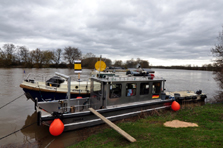
    Information: After two years of using my floating workshop (WRB9), I would like to give some information about the work that can be carried out in and with this barge. The very solid construction of the work boat is designed for pushing, so that with my pushing bollards on the bow I can manoeuvre broken-down ships of any tonnage without effort, especially in the narrow canal. The large workbench with a vice inside means that a great many repairs can be carried out, for example on water or oil pumps, and on small motors and all kinds of electrical appliances up to the size of a washing machine. A crane on the WRB9 can also lift larger outboards out of the water so that I can repair them or carry out a normal service. There is also a welding set available which can easily weld ordinary steel and stainless steel from 1 mm up to a thickness of 8 mm. There are plenty of hand-held power tools to make work in wood, GRP, aluminium or steel easier, in the barge or on other ships. A high-pressure cleaner can also be used for cleaning a whole ship, or especially for cleaning the underwater hull. I would particularly like to point out that with this high-pressure cleaner and the appropriate accessories I can clean pipes and hoses from the inside. Especially interesting for the waste and sewage pipes that keep blocking up. That saves you the extremely laborious job of changing the pipes in a cramped ship, if that is possible at all. In connection with the cleaning, all painting work inside as well as outside can be carried out very accurately. On steel ships, removing rust from small patches while extracting the removed material at the same time is one of my specialities. In everything I do, and especially with a repair, my attention is on looking for the cause: why the repair became necessary and how it can be prevented in future. This habit came from improvising on my several North Atlantic crossings and from years spent in the Arctic. There, especially on other people’s ships, with a lack of material it was mostly a matter of getting on so as not to lose the ship. This work of over 20 years, some of which I also spent working at the yard at Smelne, and constantly living on ships give me the basic knowledge to prepare ships for a big voyage or for living aboard permanently. In this connection I install new systems (solar panels, water treatment units, heating, and so on) so that life becomes more comfortable and more independent. Sourcing parts and equipment is an important aspect of this too, and thanks to my long-standing business relations with German and Dutch manufacturers it leaves nothing to be desired. It should also be mentioned that I have a complete set of diving equipment. So I am able to clean underwater hulls in the water and also to change bolted anodes without having to put the ship in dry dock. A very cost-saving method which I have been using myself for years, saving the horrendous crane fees and the time spent looking for a suitable crane. The shaft assembly and the propeller can also be inspected and, if necessary, cleaned. Finally I may bring my new ATV to mind as a fast and manoeuvrable means of transport. With this machine I can bring not only my own tools and materials but also firewood, diesel, water and so on to the remotest berths of ship owners. All in all, I try to provide a complete service that leaves hardly anything to be desired. Should a matter nevertheless seem unsolvable, you can rely on my talent for improvisation and my years of experience as an expedition leader in the Arctic. You can get in touch on tel. no. 0049151 / 15 84 33 37 or by email, harald-paul@haraldpaul.com. Many thanks for your trust.

    • Position: 43° 18.272´ N 003° 05.417´ E
    • Wind: W / 4-5 Bft
    • Weather: sunny / 23.1 °C
    • Water temperature: Water: 25.0 °C

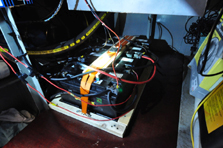
    You always meet twice in life. I worked on this Smelne Vlet with aft cabin from 2008 myself, at the yard in Drachten, Holland. For that reason it was easy to meet the wishes of the owner from England. The job was to change the batteries and lash them down securely for sea. Because of the new size of the batteries, wooden spacers had to be cut to fit. As a result the new ATV and the worktop on the front carrier were put to use straight away.

    • Position: 43° 18.271´ N 003° 05.417´ E
    • Wind: calm
    • Weather: sunny / 38.3 °C
    • Water temperature: Water: 25.0 °C

    Gravedigger: Whenever I see a plastic sack floating in the water, I usually know that something has been dumped there. From a distance I could already see flies circling over the sack through the binoculars, which made me certain that I would find a carcass. What moves someone to put a dog into a plastic sack and then throw it into the canal, you had better not ask me. Outwardly there was nothing wrong with the dog (about 6 – 8 years old), except that it had a few hairless patches that were already turning black, with larger growths on the hind legs. I got the dog out of the water because some people who live permanently on ships in this canal depend on the water, which is already heavily polluted. Some even use it as drinking water to save money. So I paid the dog its last respects and showed the respect due to a creature by digging a decent grave despite the heavy heat and burying it in it.

    • Position: 43° 18.273´ N 003° 05.417´ E
    • Wind: W / 4-5 Bft
    • Weather: sunny / 34.8 °C
    • Water temperature: Water: 26.0 °C

    The ATV in use for the thirsty animals. Enjoy watching.

    • Position: 43° 18.319´ N 003° 06.719´ E
    • Wind: E / 2-3 Bft
    • Weather: sunny / 38.6 °C
    • Water temperature: Water: 21.0 °C

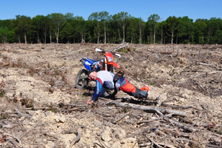
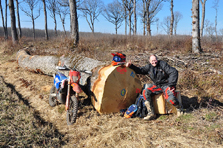
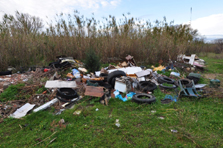
    On my excursions with my sports enduro I unfortunately keep finding rubbish dumped like this. Personally I cannot understand it at all. If you believe the media, the world, or rather nature, is being chopped up, wiped out and destroyed by serious problems such as melting ice, polar bears dying out, rising water levels, insects in billions of tonnes, by all sorts of things. But is it not the case that people want to talk a lot about these media reports and do little? That is exactly what is wanted: talk a lot, burn a lot of money, but achieve no result, so that it always stays interesting for the media and all its believers. How can it be that nothing is done about such clear offences against nature? Is it perhaps not good enough for media publicity? Or do people still believe that nature heals such dumping by itself? By now it really should have become clear to mankind that we actually live on the earth in nature and do not necessarily want to spend our time among dumped computers, fridges, old mattresses and other junk. By the way, today I happened to come past the same spot again. A second load had been dumped next to it. I just did not have my camera with me to record it in pictures. But the sight was no better. A note about my sports enduro, which I bought in Europe and actually wanted to sell again in Europe: the following hurdle came up in front of me. I was told the vehicle cannot be registered in France because it was not bought in France. But KTM is an Austrian manufacturer from which the French buy their goods, that is motorcycles, with the same documents that I have for the vehicle. However, with an additional payment of around 500 €, getting the French registration would be perfectly feasible. That is why Paul, at nearly 60, carries on riding his sports enduro. For one thing so that he can report on the spot about illegal rubbish dumping like this and other events. The new boards leaning against my enduro in the photo I took along for my store on the WRB9, so that I do not have to buy them in the shop for a lot of money. Put another way, I picked up the money from the street, in this case from nature, and in doing so reduced the rubbish a little again.

    • Position: 43° 18.319´ N 003° 06.717´ E
    • Wind: W / 4-5 Bft
    • Weather: cloudy / 19.9 °C
    • Water temperature: Water: 20.5 °C

    The new report “Freshwater Sailors” is finished: it describes the onward passage in the Mediterranean from France to Spain, with all its escapades, with regard to handling the tow under way and anchoring in rough sea conditions. The time we spent on the river Orb, which flows into the Mediterranean, with all its warm acquaintances and experiences, is also recorded in photos and text. All in all another chapter from our journey “Heat Instead of Ice”. A short note for all new readers of our website: the “Paul’s Reports” are extended pieces of information on various subjects, researched by me personally on the spot, which I describe with plenty of photos and text. This report is already number 27 and is comparable to a chapter from a book. All the reports complement one another and make up a variety of information and an unusually large number of photos, so that it is easier to put yourself in the picture. Anyone who is interested can find out under the heading Sales on this site how quickly and easily you can obtain such a report. Happy reading.
    • Position: 43° 19.319´ N 003° 09.305´ E
    • Wind: NW / 4-5 Bft
    • Weather: cloudy / 16.5 °C
    • Water temperature: Water: 21.0 °C

    Lottery: For a few days now we have been under way again with our tow. Not further into the Mediterranean, but back into the canals of France. The current corona situation, and also a great many additional points that we find hard to digest in the Mediterranean area, made us decide on this after long consideration. Despite the shallow depth we have entered the world-famous Canal du Midi. This canal and the Canal de Garonne connect the Mediterranean with the North Atlantic. How far we can get through is a lottery for us with the draught of Gypsy Life. There are many figures given for the depth of the canal. What is correct is that it has a guaranteed depth of 1.40 m. To keep such a guarantee, the actual water level has to be 1.60 m or more so that fluctuations in the water can be dealt with. How far that is put into practice in France we will certainly find out. So it is possible at any time that we cannot get any further and have to turn back. Even so, every metre covered so far has been an experience.

    • Position: 43° 15.581´ N 003° 18.376´ E
    • Wind: calm
    • Weather: sunny / 14.8 °C
    • Water temperature: Water: 13.0 °C

    The boss’s place: the “utility atv” is now ready for use. I have made use of the enormous payload of 140 kg. On the rear carrier I fitted two baskets so that the ship’s cook has an easier time loading lots of small items safely and quickly. On the front carrier I mounted a worktop. It is meant to serve as a small workbench when working on ships that I reach by land. A vice that can be fitted quickly rounds off what it can be used for. Because 85 % of all ships that are designed for longer voyages have no workshop, which really ought to be the top priority. But unfortunately the money only goes into berths and other comforts. That way, in narrow canals, which mostly have a struggle with shipping, I am not so dependent on the WRB9 for smaller repairs. By the way, all the materials used (including the rubber mat for the worktop) come from the illegal rubbish dumps around our ships. So I did not have to buy anything and was able to reduce the rubbish a little.

    • Position: 43° 15.581´ N 003° 18.376´ E
    • Wind: W / 4-5 Bft
    • Weather: sunny / 31.5 °C
    • Water temperature: Water: 11.0 °C

    Invest in bad times and cash in during good ones. Following this motto, our business has got a new vehicle. It is an ATV (all terrain vehicle), which is meant to improve the work and the supplying of our ships, especially in bad times. Since I broke my collarbone we have realised that Silvia can only keep up the provisioning to our remote berths by bicycle with great difficulty, especially after heavy rainfall. Fetching diesel or petrol for the generators and carrying firewood also came to a complete standstill. Furthermore, we are now also better equipped to clear up illegal rubbish dumps around our berths. The four-wheel-drive tractor unit is also meant to be able to help other skippers with obtaining materials or fuel. A winch with 1.3 t of pulling power will certainly find a use here and there. On top of that there is a towing hitch that makes it possible to transport goods of up to 600 kg. My lighter (WRB9) was designed for this when it was built. The loading ramp and the cabin door are wide enough for this vehicle to be loaded from the unmade bank and driven into the workshop. To my regret I have to part with my sports enduro, which gave me many fine and good hours of training. Instead my adventure bike, which was built for such challenges, is now being used. I am already training off-road with this two-cylinder hammer of over 200 kg and 125 hp, so that I get back my skill and fitness after the time out with the collarbone. Because from now on the motorcycle will be used more and more off the roads. Here difficult stretches have to be mastered again in order to get unique photos for you as a website reader, report subscriber or for the magazines.

    • Position: 43° 15.584´ N 003° 18.375´ E
    • Wind: calm
    • Weather: Partly cloudy / 26.3 °C
    • Water temperature: Water: 10.0 °C

    Surveillance: somewhere in the internet media I read that because of corona we are in a state of war. How anyone arrives at such a comparison is probably questionable for many people. But since yesterday I almost believe it myself. During my training run on a fallow meadow about 200 metres away from us I was watched from the air by a helicopter for quite a long time. For months I have been treading a circuit of about 600 metres there through the wild-growing grass. That is where I do my laps, combined with a few exercises which at the moment are meant to train the shoulder area together with the upper body. A helicopter that patrols along the beach about twice a day circled over me for a very long time. At the moment I run 10 laps there. For about four of them the heli circled above me. If I reckon around 60 minutes of training time for the laps mentioned, the heli was above me for a good 20 minutes. Since there is nothing far and wide but meadows with horses grazing on them, I really am of the opinion that the heli had it in for Walter and me. The terrier and I carried on with our laps without restriction, but allow me to ask what the point of such an operation is. Especially as an aircraft like that burns about 250 litres of kerosene per hour, depending on its size. So this operation used up about 85 litres. Unfortunately I did not have a camera with me to record such a heroic deed in pictures.

    • Position: 43° 15.582´ N 003° 18.376´ E
    • Wind: calm
    • Weather: sunny / 15.6 °C
    • Water temperature: Water: 9.0 °C

    In view of the many visits to my website from abroad, in future I will, for fairness’ sake, do my little films in English. As this language is a foreign language for me too, and so what you hear will never be native-speaker English, I hope people will forgive me. The reason is that a text can be translated by a program into the language you have chosen. Films, though, you hear (unless they have been translated separately) only in the original language. I just wanted to show you the crabs I caught on the bank. That one of them would nip me straight away so hard that it bled properly was not intended. They are simply the water police and clear away everything that comes in front of their pincers, even if it is only a finger. Here in France we are still bound by the curfew until 11 May. How things will go on after that is at the moment only speculation. My collarbone is doing quite well so far, so that after six weeks off I was able to do a first careful training session on the motorcycle.

    • Position: 43° 15.582´ N 003° 18.375´ E
    • Wind: SE / 2-3 Bft
    • Weather: sunny / 18.9 °C
    • Water temperature: Water: 8.5 °C

    Independent and free: It is precisely in the coronavirus situation that independence makes itself felt to the full. But it only works if, as already mentioned, you have cut back to the basics years beforehand and kept your distance from abundance. So the three most important components are: water, food, and a place to stay with a means of heating and cooking. We are able to turn any kind of water, whether salt water or dirty fresh water, into drinking water. Against chemical contamination, though, we are powerless too. If you do not expect a three-course meal every day, simple food fills you up quickly. Our ships are space enough to stay in without being dependent on others. The heating and cooking arrangement, tried and tested for years in the Arctic, is the best thing we have. And the stove also heats the service water, so that we can enjoy a warm shower. This independence makes us free.

    • Position: 43° 15.582´ N 003° 18.374´ E
    • Wind: calm
    • Weather: sunny / 12.5 °C
    • Water temperature: Water: 9.0 °C

    Trachemys scripta elegans, a red-eared slider that I found yesterday, is staying with us on the ship for a while for further observation. According to the internet this little two-year-old turtle comes from America; in the seventies they were exported to Europe in their millions as living toys for children at one dollar apiece, and when they grew to an inconvenient size they were simply let loose. This, and the fact that such turtles live to a good 80 years, has meant that they have mostly displaced our native turtles and so taken the monopoly. According to the internet, conservationists are not entirely happy about this, because they appear in such numbers and by doing so also harm the water flora.

    Information: In view of the situation created by the coronavirus and the restrictions that go with it, which will certainly not change in the foreseeable future either, I would like to make the following offer. To make the long waiting times caused by the movement restrictions more pleasant for a certain period, when you buy my items, one of the DVDs or the book “Northbound”, I will send them free of postage within Germany, excluding the islands. If you buy all three items, 74.70 € in total, I will grant a discount of 14.70 € on top of the free postage, so that only 60 € has to be paid for the items. As a one-man business in such an exceptional situation I can unfortunately only keep this offer up for a certain number of items. I ask for your understanding and wish you much enjoyment in advance. Anyone who is interested can send me an email with the order to harald-paul@haraldpaul.com, which is then also gladly available for any questions that come up afterwards. Furthermore, in closing, may I point out my reports “Paul’s Reports”, which deal strikingly, in text and pictures, with many topics relating to ships, nature and travel. Here too a short email is enough to receive them sent as PDF files, on payment of a contribution towards costs of 3 € per report.

    • Position: 43° 15.581´ N 003° 18.376´ E
    • Wind: S / 1-2 Bft
    • Weather: cloudy / 13.5 °C
    • Water temperature: Water: 7.0 °C

    Back to basics: My collarbone is not doing badly, considering the circumstances. The pain becomes bearable, or perhaps you just get used to it. In any case I had to stop the painkillers prescribed by the hospital with immediate effect, because a connection with a histamine allergy that has recently come into my life could not be ruled out. All in all I have now been slapped in the face twice. Because with the effects of such an allergy you are at the moment completely on your own in life. The doctors are not taking patients, the hospitals are overcrowded and everything else has come to a standstill as well. Whether these measures introduced by the countries have any effect will certainly become clear in the near future. Whether the economy survives it, including the solemn promises of the politicians about rescue payments, will too. But one thing can be assumed quite clearly: in the near future things will no longer be as they were. Restrictions will hit humanity in full. The sooner you start with them, the easier they come to you. We have lived through them over the last 20 years, right down to the basics, and are practised at dealing with them. So, as we keep publishing, we have no problems or panic attacks to suffer because leisure activities have come to a standstill. Over the last 20 years we have had to fight for survival, whether financially or materially. That is how we came back to basics, and we will probably cope with the coming restrictions too. We wish all our website readers steady staying power.

    • Position: 43° 15.581´ N 003° 18.376´ E
    • Wind: E / 2-3 Bft
    • Weather: cloudy / 14.8 °C
    • Water temperature: Water: 7.0 °C

    Grounded: Walter is enjoying the best of health, now it is Paul’s turn. He has unfortunately broken his collarbone and is out of action for quite some time as a result. A fall onto the shoulder, onto a concrete slab overgrown in the tall grass, broke the collarbone in two. According to the X-ray the break looks very good and clean and so did not have to be operated on. Now a figure-of-eight bandage should be worn for about three weeks. After that it depends on your own fitness and on how the bone builds up how far the shoulder is fit for use again. The rule of thumb, though, gives a recovery time of 8 – 12 weeks. Will Paul stick it out?

    • Position: 43° 15.582´ N 003° 18.376´ E
    • Wind: calm
    • Weather: sunny / 12.2 °C
    • Water temperature: Water: 7.0 °C

    State of emergency: As everywhere in Europe, and as is known from the media, a 14-day curfew because of the coronavirus has been declared here in France as well. Whether the authorities collect a 3000 € fine for not complying, as reported from Spain, I do not know. Because here at our present berth numerous anglers go past in their boats and try their luck, as usual at weekends. What is more, this curfew does not even prevent the illegal dumping of rubbish that was done here within a few hours along this bush-lined field track, which I walk along several times a day with Walter. Perhaps I am simply not properly informed and nature has been declared a public rubbish tip on this stretch. So from this state of affairs I see that in such a threatening situation people do not come to their senses and understand that Mother Earth has to be respected. That is why I am thrown back onto the hard facts again and again: most actions take place for the sake of money, for steering the people and for power over the economy, and so they are hardly any help as far as nature and the creatures living in it are concerned.

    • Position: 43° 15.584´ N 003° 18.375´ E
    • Wind: calm
    • Weather: partly cloudy / 16.3 °C
    • Water temperature: Water: 7.0 °C

    Necessity is the mother of invention. That fuel, in my case mainly diesel, costs more at the waterside fuel stations than at the pump inland was well known. That the price difference can be screwed up to as much as 50 cents per litre is a rabbit punch as far as I am concerned. So I had to extend my independence against this price gouging. The challenge was to find a way of picking out the cheapest pump inland and getting the fuel to the ship under my own steam without any outside costs. Without further ado my heavy touring enduro was turned into a transporter for a good 80 litres of the stuff, which here in France is yellow. With the price difference of around 40 euros on every trip, the two to three litres of petrol for the motorcycle are easily paid for. So we have gone one step further towards independence again.

    • Position: 43° 15.582´ N 003° 18.375´ E
    • Wind: NW / 7-9 Bft
    • Weather: sunny / 18.9 °C
    • Water temperature: Water: 8.5 °C

    At this quiet berth I am making progress with my work on the onward passage at sea as a towing combination, despite the weather. The whole test week at sea brought many insights which need to be put into practice on the ship. As can be seen on the short video, the forward mast has already been taken down. Only a short makeshift mast is left to carry the day shape, which can now be seen very well from ahead and from the side. The after mast with its steadying sail stays unchanged, because it has to do its job as a support against rolling, at anchor and, when the lighter is coupled up, as a direction keeper in the wind, and in an emergency on the parachute sea anchor.

    • Position: 42° 25.188´ N 003° 18.255´ E
    • Wind: E / 1-3 Bft
    • Weather: sunny / 16.5 °C
    • Water temperature: Water: 10.5 °C

    Return to France: We have decided to withdraw again to our old bamboo spot on the river Orb in France. The reason is some further work that is needed for lying rafted up with the ships in waves or swell. This includes taking down the forward mast. With its rigged shrouds it gets too much in the way of our rope work in connection with the lighter. The noise and the swinging about without way through the water, caused by gusts of wind, also have to be reduced. Besides, the day shape of the towing vessel of my tow is hard to see when the sail is set and the mast is in the way. But with a tow length of nearly 60 metres, depending on the sea state, I have to warn other skippers against passing between us, and I want to draw attention to my restricted ability to manoeuvre. As the behaviour of the skippers has shown in practice, most of them do not know the day shapes anyway. Furthermore, the height of nearly eight metres is often critical at river entrances and the bridges that go with them. With the after mast we have a height of only six metres. I do not want to speak of a standard, but coming in from the sea the bridges are often around 6.50 metres high. That way some of them can be passed, so that we can carry on upriver and get out of the waves and swell. We are able, as tried out in Spain, to lie even in a fair sea state, but this involves an enormous amount of time to get all the ships into the right position relative to each other. My task in the future, though, is not to look after our fleet exclusively, but to be able to provide paid help to others. In general a great deal of the work on our own ships has to be organised more efficiently, otherwise the days bring more than 14 hours of work without any payment at all. On my sponsored expeditions to the Arctic the cards were dealt differently as far as income was concerned. Now there has to be sharp calculating and hard work. Whether we will manage that at sea as well as we did on the quiet rivers remains to be seen.

    • Position: 42° 19.352´ N 003° 18.466´ E
    • Wind: N / 1-2 Bft
    • Weather: sunny / 10.5 °C
    • Water temperature: Water: 10.0 °C

    The wind and the waves have died down, the sun is shining and it is pleasantly warm. That quickly makes you forget all the exertions of the past few days. When we arrived in this bay a few days ago, small memories came back of (Bjonoya) Bear Island in the Barents Sea, just short of (Svalbard) Spitsbergen. The steep cliffs, with the waves breaking against them and the screeching gulls above them. That is why I was completely shocked when I suddenly made out a whole crowd of people with smartphones in their hands on top of the cliffs, photographing our entry like mad. When I landed with the FB5, a cluster of people immediately gathered around me, watching closely what I was doing and pestering me with endless questions. I could not let Walter go at all, although after a sea passage he likes to do his business, because otherwise he would have been passed through countless hands. I was forced to use my elbows a bit, otherwise the cluster would not have broken up. After a few steps a sign caught my eye, see photo. Of the ten activities shown, eight are forbidden and only two are allowed. Some of them ought to be taken for granted by anyone with a decent upbringing anyway, especially these days, when every insect in a room is carried outside. Even so, I think it would be time in future to put only what is allowed on the signs, since that list is considerably shorter than the prohibitions. Because the signs would become enormously smaller, this would be a great contribution to nature conservation, as fewer production steps would be needed and considerably less raw material would be used.

    • Position: 42° 19.352´ N 003° 18.446´ E
    • Wind: NW / 7-8 Bft
    • Weather: sunny / 13.8 °C
    • Water temperature: Water: 10.0 °C

    Walter the terrier has almost completely recovered. That is why we were able to take up the onward passage and have reached Spain. In mid-February the Mediterranean, too, has a few weather situations in store for you which, together with the challenge of having to cope with them with three boats in a towed convoy, can quite well be called demanding. On a sea leg of about 60 nm we lost our WRB9 together with the FB5 on the open sea when the tow lines parted. Catching them again in a sea state of around 1.0 – 1.5 m was sporting. Unfortunately we did not manage to link the train up again, so I had to reach the destination under my own power with the WRB9 and the FB5 in tow. I am not going to claim that this was intended, but such experiences and practice are part of our everyday life, which is meant to round off the series of tests with the towed convoy. Once we had arrived at our destination, a picturesque bay, the ground tackle and the rest of the equipment were once again put thoroughly to the test. For two days now a NW wind with a good swell running into the bay has been keeping us moving, in the truest sense of the word. Silvia’s enthusiasm for the test series is limited, but the fine, sunny and warm weather quickly makes you forget all the effort.

    • Position: 43° 15.582 N 003° 18.375´ E
    • Wind: E / 3-4 Bft
    • Weather: cloudy / 12.2 °C
    • Water temperature: Water: 6.0 °C

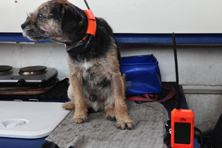
    The terrier is better, considering the circumstances. The wound is healing as a primary and secondary wound together. In the meantime I have bought a special tracking system for the dog. It is meant to show me the dog’s position, especially in bad weather conditions, wind, the noise of the surf or heavy rain, and at night. The transmitter the dog wears picks up the coordinates via GPS and sends them by radio waves to my receiver, up to a distance of about 25 km. The receiver shows me with an arrow the direction of the dog’s position, the distance, and whether the dog is moving or standing still. That makes me completely independent of other radio networks and gives me a link to my dog in absolute wilderness, or in mountain country in particular. At the moment I am busy mastering the settings and the handling in practice together with Walter, so that every move is right when it really matters.

    Walter
    • Position: 43° 15.582 N 003° 18.375´ E
    • Wind: calm
    • Weather: rain / 10.0 °C
    • Water temperature: Water: 7.0 °C

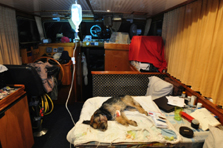
    Last Monday the WRB9 (workshop ramp boat) was turned into an operating theatre. Transporting the terrier was not possible because of his poor condition. My workbench was covered with hand towels and surgical drapes for sterility. The work light was aimed at the dog, so that the vet and I could examine the wound closely. Thanks to my intensive care it had largely cleaned itself, so it was now time to close it with several stitches. The challenge: telling the cells that had already died from those that were still alive. Unfortunately, because of the heavy contamination, a lot of dead tissue had to be removed from the wound. The injury thus took on an extreme size that was very difficult to stitch. Even so, the vet managed to close the wound to a large extent, in order to prevent a fresh infection as far as possible. My task now is to keep any possibility of infection away from the dog, and to care for the injury, which was stitched under strong tension. Giving him medication, putting ointment on the whole wound and dealing with the many parasites (fleas, ticks) he picked up in the sett. For the next 14 days this will be my main job. So the onward passage is, understandably, interrupted for an indefinite time.

    • Position: 43° 15.582 N 003° 18.375´ E
    • Wind: calm
    • Weather: dark / 7.5 °C
    • Water temperature: Water: 7.0 °C

    Field hospital: For three days the crew of Gypsy Life has been working flat out. Last Thursday at 20:30, after his walk, Walter picked up the scent of a badger just in front of our ship and attacked it fiercely. Lately, because of the many rats brought on by the masses of rubbish at our bamboo berth, he has constantly been busy keeping such unwanted guests away from our ships. That he did not spot the difference at that moment is probably down to his terrier hunting passion. He followed the badger further than usual. I could not follow his trail because of the darkness and the dense bamboo with the undergrowth that goes with it. Following him by ear was not possible either, because of the loud wind noise from the well-known low-pressure system and the roaring surf not far away from us. So within a second the connection between us was broken. I started a search at once, because from my hunting experience I knew that the balance of strength would with absolute certainty be in the badger’s favour. It has very short teeth, but a bite force that no other wild animal in our latitudes can match. Equipped with a thermal imaging camera and ordinary lights, I searched until 03:00 without success. From midnight on I had widened the search radius by using my sports enduro. After a short break during heavy rain, I took the search up again together with Silvia at 06:00 and kept it going all day. We looked above all for a badger sett, which really ought not to be very far from us. But because of the countless rabbits that romp about close by here, there are masses of burrows in the ground. Finding them all and judging them by size takes a great deal of time. The following night, when I was out again with my thermal imaging camera on foot and, for the longer distances, with the sports enduro, was also without success. The hope of finding him again shrank by the hour, because I knew that a badger is thoroughly familiar not only with fighting but also with digging its opponents in. In practice that means that a dog in a badger sett, especially one dug in sand, is literally buried and suffocated. Late in the afternoon of the same day, after he had been missing for 44 hours, I took a call in French from a hunter I know. As a precaution I had always put a collar on Walter with my telephone number on it. He had found the dog not far at all from our berth, lying on the ground completely exhausted. When I took the dog over, after he had probably survived all that long time shut in the sett and then an exhausting escape under his own strength, a foul stench hit me. A close examination of the animal showed me that both eyes were completely clogged with sand and pus was already coming out of the eye sockets. That all the flesh on the right side of his lower jaw had been torn away and there were deep holes. These bite injuries are very typical badger bites, which it can inflict with its incredible bite force. This enormous wound, too, was completely full of pus because of the contamination with sand. The dog hardly responds to my voice any more. Although I am familiar with such injuries and can also treat them, I decided to go to a suitable clinic. Two French acquaintances found the clinic that came into question, arranged an immediate appointment and drove me there. With the English-speaking vet we were able to prevent the worst after about three hours of treatment. Normally, with injuries as serious as this, the dog stays at the clinic. But because of my express wish and the professional nursing skills the vet had observed, the dog was given to me to take along. So the ship was turned into a field hospital. The hardest challenge of the coming days is to stop the injuries from becoming infected. With wounds of this size it will certainly take weeks until he has fully recovered

    Walter
    • Position: 43° 15.582 N 003° 18.375´ E
    • Wind: NW / 7-8 Bft
    • Weather: dark / 9.5 °C
    • Water temperature: Water: 7.0 °C

    The low Gloria is drawing its tracks over us as well, with wind and continuous rain. Although we are lying somewhat off to the side of the centre of the low, the sea is running quite high. The wind mixed with rain does not make the business any more pleasant. In the surrounding harbours there is chaos from boats that have broken loose and are damaging others. We are lying here in our river, with the ground tackle laid out and moored to the bank, and so far quite well off. Swell, which makes itself strongly felt from the sea, keeps our fleet moving. Ships that are exposed to swell can hardly be tamed. You are constantly at the mercy of its jerky movements, and that badly affects everyday life and your night’s rest. Even so, compared with the hurricanes off Greenland, which in winter swept over us twice a week at well over 200 km/h, this is a moderate refreshment.

    Beach
    • Position: 43° 15.582 N 003° 18.375´ E
    • Wind: NW /1-2 Bft
    • Weather: dark / 10.5 °C
    • Water temperature: Water: 7.0 °C

    As you can read from the coordinates, we are still lying in the same place among the tall bamboo. Which, incidentally, like other plants, is already starting to push out new leaves again. But the fresh green is heavily overshadowed by illegal rubbish dumping of the kind you can see in the photos. These photos show only a fraction of the reality. Every spot out in nature that is a little remote but easy to reach by vehicle is mercilessly buried in rubbish. My enquiries on the spot have shown that there is no need at all to dump the rubbish there, since disposal at the well-known collection points is free of charge. So of course the question arises for me: why does someone drive a vehicle into the last corners of nature, perhaps even risking damage to the vehicle on the rough ground, in order to dump things there in secret? Is it perhaps the thrill of a punishable act that you do not want to be caught at? I have seen this compulsion to dump something in the wilderness in other countries too, such as Canada, Greenland, Spitsbergen, Scandinavia, the UK islands and so on. To this day I have not found the sense in why it is done that way. Because if you believe the media, people are ready to turn the world upside down for the protection of the environment and of nature. Renewable energy, protection of insects, CO2 reduction, curbing global warming, reintroduction of wolf and bear, just to name a few key words. All brilliant intentions that you can discuss for hours without doing anything, and that can certainly be marketed well, so that at least one thing gets moving: money. Whether humanity should carry on like this for the next decade is something everyone can answer for themselves. In any case I have set myself the goal, on top of my own lifelong rule that we leave nothing behind that proves we were there, of using every possibility in my power to clean up the places I call at. So I can make limited runs with my travel enduro to the nearest collection point or to the containers put up there, and in that way free the immediate surroundings of our berth from rubbish. If I call at 20 places in a year, then at least those are free of rubbish. It is certainly only a small beginning.

    Rubbish
    Rubbish
    • Position: 43° 15.582 N 003° 18.377´ E
    • Wind: variable / 1-2 Bft
    • Weather: sunny / 17.5 °C
    • Water temperature: Water: 7.0 °C

    We are still in the same spot, sheltered by tall bamboo, lying in the river Orb, which connects to the Mediterranean. But before long we will move further south, towards Spain. So, fittingly at the turn of the year, we would like to thank the French people most warmly for their enormous hospitality. In the almost two years of our stay we have met very warm-hearted and above all friendly people who, despite our more than miserable knowledge of the language, were always ready to find a conversation. A very warm thank you as well for the gifts of firewood, water and even bread fresh from the oven. For next year I am toying with the idea of travelling to the Balearics (Ibiza, Mallorca and Menorca). I mention it because word has reached me that having your boat repaired in the harbours there is very costly. Not only the hefty hourly rates on top of the already more than salty berthing fees, but also the harbour surcharge for an outside firm makes many a skipper snort with rage. As I have mentioned several times, my floating, mobile workshop has seen a good deal of use this year. Even on Christmas Eve a bent rudder stock was brought back to size by cutting out the damaged parts and welding in new components, so that the skipper could enjoy his time off on the boat over the holidays. As we are travelling slow ahead, one or two people may find it possible to plan ahead for an upcoming service or repair. I may also note that I am quite flexible on the road as well, equipped with my travel enduro and its panniers. I can reach more distant destinations inland too, without any problem. Anyone who is interested is welcome to contact me on tel. 0049151 /15 84 33 37 or by email at harald-paul@haraldpaul.com. Finally, I would like to wish all our loyal website readers, report subscribers, repair customers, acquaintances and everyone who knows us a good start into the new year 2020, together with the best of health and much success.

    Sunset
    • Position: 43° 15.594 N 003° 18.375´ E
    • Wind: SW / 9-10 Bft
    • Weather: cloudy / 13.3 °C
    • Water temperature: Water: 7.0 °C

    Greetings from the North Atlantic: at the moment the low-pressure systems (turning anticlockwise) over the North Atlantic are very extensive, so that, coming from America, they reach far below the line of the Azores. One such trough has snaked its way through Gibraltar and pushed on up the east coast of Spain as far as our position here. In Greenland and Iceland winds of this strength, 25 m/sec, are called a moderate freshening. Here in the Mediterranean that is more like the upper mark along the coast. Our gear held without any problems and suffered no damage. It was different for some of the boats around me, a few of which broke loose in the harbour and damaged each other. A sailor I know had his small sailing boat, which he had made fast to a mooring buoy in mid-river, washed ashore. With the WRB9 I only just managed to pull him off the bottom. His steering gear (fin rudder) was completely destroyed by the grounding combined with the waves. It reminds me of the dangers on our expeditions that came several times from the Silentwind wind generators, from parts flying about and from the overvoltage in the ship. Sometimes there was considerably less wind and yet the Silentwind wind generator, supposedly tested up to 12 Bft ( 32.7 m/sec), gave up and became a danger to the life of bystanders. Anyone who would like to know more can look at the incidents again, with photos, under News. For the time being, as can be seen in the photo, we will stay on a little longer in our bamboo corner. We wish all our website readers, the report subscribers and everyone who knows us a happy Christmas.

    Bamboo
    • Position: 43° 18.670 N 003° 41.948´ E
    • Wind: NW / 6-7 Bft
    • Weather: partly cloudy / 13.5 °C
    • Water temperature: Water: 9.0 °C

    Miracles do happen now and then. The word was that the strike would reach its peak today and that everything would therefore be completely paralysed. But a try at phoning the authorities was worth it all the same. Lo and behold, the bridges were opened today. Unfortunately the approach to the first bridge lies exactly in the NW wind direction, so we had a following sea. Of course the first bridge did not open on time as laid down, but with a considerable delay, so that we had to do a fair bit of manoeuvring with our tow in wind and waves in a confined space. As all the floating units are in different weight classes and each therefore has its own motion in the sea, the towing gear was tested for its durability. Out at sea there was a short passage of 20 nm ahead, a good chance to test how the WRB9 behaves. It ran surprisingly neutrally behind Gypsy Life. All in all it worked well, although we were running close inshore and the waves came from the side and were no more than a metre high. The first speed test says 7 kn at three quarters engine load. At normal cruising below 1800 rpm the loss of speed is about 0.8 kn. So we have now arrived in the Mediterranean and are carrying on slowly southwards.

    Gypsy Life
    • Position: 43° 26.074 N 003° 41.946´ E
    • Wind: N / 6-7 Bft
    • Weather: cloudy / 13.5 °C
    • Water temperature: Water: 8.0 °C

    A misunderstanding: yesterday evening we moored at the waiting quay of the first bridge as a precaution, so that today we could pass through all of them, as agreed with the shift supervisor for the bridges. As the bridges again did not open today, I grew a little suspicious and walked up and down the street until I met a Frenchman I could make myself understood with better. Result: the bridge is not broken at all, they are on strike as they were last winter. The French have taken the yellow vests out of the drawer again, dropped everything and gone out onto the street. There is no hope of achieving anything here to get on your way. There is no end to the strike in sight. There would be another possibility of reaching the sea. For that the masts would have to be lowered again and one bridge lifted. But during a strike nothing gets lifted. On top of that there was a fresh wind with waves to match when we moved back from the quay to our anchorage. Just right for the first test with the tow and its towing gear. The WRB9 ran quite calmly behind Gypsy Life and so hardly affected our headway. When re-coupling, though, I noticed how much wind resistance the barge puts up, so that I could hardly hold it by hand. Now we are lying in the inland lake again at our previous anchorage and have to wait. Nobody knows exactly when things will move on.

    Gypsy Life
    • Position: 43° 26.086 N 003° 41.946´ E
    • Wind: SW / 2-3 Bft
    • Weather: sunny / 9.8 °C
    • Water temperature: Water: 7.5 °C

    Anyone who has read my reports on France (No. 24, 25, 26) knows a little more about the ways of the French waterways. Over the past weeks we have prepared everything for going out to sea, working many hours into the night so that everything is ready on the three ships. Registered as required for the five lifting bridges in Sète, so that we can pass through with our masts up. But unfortunately we had not reckoned with small mishaps. One of the five bridges has not been working for days. The repair may take a while, according to the authorities. So it is a matter of waiting again. Because it is not only the bridges that have to be passed; from now on an eye also has to be kept on the weather situation. The towing ship can come through any sea, but the tow still needs a few series of tests, so that we do not have to go all out straight away and cause damage to the gear. Because one thing is clear to everyone: a passage at sea in a towing convoy like this is a particular challenge. In wind and waves you should have a good deal of routine in handling a towing convoy. Whether that is the case will soon become clear. It will be interesting, and I will report on it.

    • Position: 43° 19.821 N 003° 32.098´ E
    • Wind: E / 4-5 Bft
    • Weather: dark / 12.5 °C
    • Water temperature: Water: 7.0 °C

    Canal du Midi, a name many people know when it comes to French canals. We have gone only about a cable's length (185 m) into this famous canal, because at the moment it is the best option for us for the work still to come. Here we finally want to step the masts and bend on the sails, and then get out to sea through the lifting bridges in Sète. We have already been in contact with salt water for a few days (as can be seen in the photo from the foaming water), because many small canals connect directly with the sea. So our water plant, which makes fresh water out of salt water on the osmosis principle, is in operation. This unit had been shut down and preserved for over two years, since the voyage to the northernmost point in the Baltic. Now it helps us keep up the independence of our way of life. Because drinking water is in short supply here in the south in particular, and it is traded at a high price.

    Gypsy Life
    • Position: 43° 38.448 N 004° 24.959´ E
    • Wind: NE / 3-4 Bft
    • Weather: dark / 10.5 °C
    • Water temperature: Water: 5.0 °C

    A new report, No. 26 “Narrow Paths, Steep Mountains, Deep Locks”, is finished. With its 35 photos and 5055 words, or 31111 characters, this report closes off our stay in France, which lasted almost 1.5 years. France, the country with its countless waterways, often lying flat in the landscape or running through deep valleys, is what I have tried to bring closer to the reader in this report in particular through my photos. Small peculiarities and pieces of information that a traveller is constantly faced with are also recorded in text and photo. Many readers of my website know that I have been publishing reports like this for some years now, so that the research done on the spot can be expressed better in text and above all in the photographs. Where the reports from the Arctic were marked by hurricane-force winds, ice, blizzards, close encounters with bears and other hardships, I can say with certainty that there is nothing of that kind on the journey “Heat Instead of Ice”. Here the order of the day is information, with photographs, especially for travellers interested in the same area. But it is also just the thing for people who only want time for a short dream. As has been usual for years, a report like this can be sent as a PDF file on request by email ( harald-paul@haraldpaul.com ) to me, for a contribution towards costs of 3 €. I wish everyone happy reading.

    Harald Paul
    • Position: 43° 38.446 N 004° 24.961´ E
    • Wind: NW / 4-5 Bft
    • Weather: sunny / 16.5 °C
    • Water temperature: Water: 10.0 °C

    Looking at the photo, at the nature with the leaves on the bushes and the tall grass, I would think that in the south it stays relatively warm over the winter as well, so that for the first time in our 20 years of life on board we would not have to heat. But far from it. Lately the thermometer has been dropping below the condensation limit of 7° at night. Even though the ship's metal can warm up through the day in the sun, it is not enough over the night, so moisture spreads. So, alongside the normal work, we are forced to look for dry trees to get firewood. When we set off two years ago we were still speculating: once you head south, do you need a heater at all? Now we are glad that we did not change anything. Here experience proves true once again, that you should not change something tried and tested just so that something has been changed. Especially when it rains heavily, it makes a lot of sense to have a heater that carries the moisture out of the interior through a chimney. The painting work I announced is already done. Now I am busy preparing the two motorcycles and the bicycle for the salt air, so that the rust does not attack them so badly. My three outboards need a service in that respect too. Besides the firewood, there is still plenty to do.

    Gypsy Life
    • Position: 43° 38.449 N 004° 24.962´ E
    • Wind: SW / 5-6 Bft
    • Weather: Cloudy / 16.3 °C
    • Water temperature: Water: 15.0 °C

    We are lying in a canal running parallel to the French Mediterranean coast. The wind, which out at sea is currently around Beaufort 9, about 22 m/sec, we only feel in a weakened form. Of the waves that go with it we of course notice nothing here in the canal. We deliberately chose this spot so that everything can be prepared again for the coming sea passage. Over the next few days the paintwork will be checked once more and a few places touched up. The warm salt water will certainly show me more places after a while. Then the whole load on the superstructures and inside Gypsy Life, the WRB9 and the FB5 has to be lashed down so that nothing can work loose in the movement of the sea. How the WRB9 will behave at sea at all still has to be seen. It has already passed small tests with flying colours, but at sea the cards are always dealt differently than expected. Stepping the masts and bending on the sails will come a little later, as there are still some low bridges to pass through. Now we are hoping for little rain so that the work can be done quickly.

    • Position: 43° 58.424 N 004° 48.764´ E
    • Wind: N / 0-1 Bft
    • Weather: Cloudy / 15.8 °C
    • Water temperature: Water: 18.5 °C

    From today we can no longer be reached on Facebook. This branch of the media, with its unmanageable amount of information that was influencing me more and more, has led me away from my actual path, life in nature. About 20 years ago Silvia and I deliberately moved a long way out of civilisation in order to strengthen our sensitivity to nature. On subjects such as game, insects, livestock farming, global warming and other nature-related questions I often brought that quality into my comments on Facebook, also as a result of my more than 30 years of work in forestry and agriculture. Mostly this became my personal undoing and I was often attacked because of it. I had to put a few things straight and, according to Facebook, did not act in line with the rules, particularly in a dispute with the biologist Micky Pleitner. They wanted to regulate my freedom of opinion. I used that cut straight away for the departure from Facebook that had been planned anyway.

    • Position: 44° 30.781 N 004° 41.529´ E
    • Wind: S / 1-2 Bft
    • Weather: Rain / 15.8 °C
    • Water temperature: Water: 17.5 °C

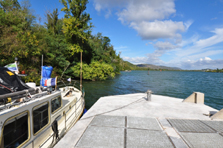
    High water: over the past few days there has been exceptionally heavy rain, which today raised the level by about 1.5 m at our anchorage in a small side water off a branch of the Rhone. Many trees and all sorts of thorny scrub have caught in the stern anchor chain. The stern anchor had been laid out upstream against the current, because yesterday we had a good S wind of 5-6 Bft and in this side water we do not have much space to let all the ships swing together. Half a day’s work and the ships were ready for use again. We are letting the first surge of high water with all its driftwood run downstream ahead of us before we take up our voyage again. According to the weather forecast the rain will go on for a few more days. All the same, the level has dropped by about 20 cm according to my mark.

    Gypsy Life
    • Position: 45° 00.999 N 004° 50.734´ E
    • Wind: S / 4-5 Bft
    • Weather: cloudy / 18.2 °C
    • Water temperature: Water: 17.0 °C

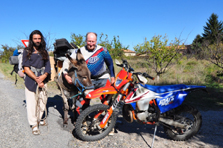
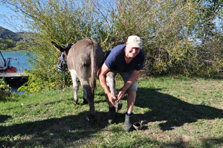
    Help for this sort of carrier too: riding past this team on my sport enduro I noticed that there was no harmony between the two of them. One pulls, the other brakes, and yet over 500 km into the north of France are supposed to be covered. I suggested to the man, who was not far from my ships, that he let me give the donkey a basic service free of charge. A limping gait from the wrong protective boots on the rear hooves, injured patches of skin caused by chafing harness, abscesses brought on by thorns in the skin, generally moderate condition. The young man had already been under way with his donkey for four weeks, and had had to break off for one week of that because the animal was ill. I spent a whole afternoon until late in the evening with the man putting everything right again and helping the donkey in that way. Boots better fitted and padded on the hooves, harness widened at the critical points, injured patches of skin and abscesses treated. Result: the donkey no longer limps and now walks in step with his herdsman.

    Harald Paul
    Harald Paul
    • Position: 45° 09.783 N 004° 48.637´ E
    • Wind: N / 3-4 Bft
    • Weather: sunny / 16.5 °C
    • Water temperature: Water: 19.0 °C

    Foot fully healed: thanks to my constant training and the exercises I am a hundred per cent fit for use again. The foot can take weight well again. Even so, I am still a little careful when walking in difficult terrain. We have continued our voyage. Here along the Rhone the first mountain ranges rise up, and as usual I want to climb them to take good overview photos for my readers of the website, my reports and the magazines. At the moment a fresh wind is blowing, which is already causing rougher waves and does not let me land on the very stony bank with the WRB9 without damage. I have to be able to unload the sport enduro so that I can then climb the summits with my camera equipment. The weather situation remains stable, so I only have to wait for slightly lighter wind. Our present berth is behind a very solid concrete block, which gives us shelter from any waves, wind and driftwood.

    Gypsi Life
    • Position: 45° 25.431 N 004° 45.069´ E
    • Wind: S / 4-5 Bft
    • Weather: sunny / 28.5 °C
    • Water temperature: Water: 21.0 °C

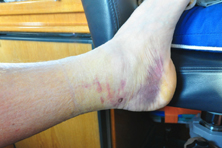
    Slight improvement: I have now been dealing with this foot for exactly three weeks. At first it was only a small thing that I hardly paid any attention to, but now it is turning more and more into a long drawn-out challenge. For the past week the situation there has got considerably worse, because Paul would not keep still. Because of the bleeding it has also become clear that it is not a pulled muscle but rather a torn muscle fibre. According to my clever book “Medicine at Sea” that takes six to eight weeks to heal. I have one week behind me now, and as you can see in the picture the bleeding has already sunk downwards and turned dark. A sign that it is no longer bleeding and that the old blood is slowly breaking down. The pain is still there, but it gets less with gentle movement. So I am already training the foot very gently without weight on it, so that after such a long time the tendons, ligaments and muscles do not start to waste away and I then have to start building them up again. In other words: healing through movement. So we are forced to stay for some time at our anchorage here in the Rhone near St Clair du Rhone.

    Paul’s foot
    • Position: 45° 25.362 N 004° 44.925´ E
    • Wind: NE / 3-4 Bft
    • Weather: sunny / 32.3 °C
    • Water temperature: Water: 21.0 °C

    For the moment the onward journey is interrupted for a while. During my last running training on Sunday two weeks ago I pulled a small muscle in my left calf. To begin with it seemed to be a small thing, so I paid little attention to it. In the past week I overstretched the foot a few times again, but it was all still within limits, so that yesterday, as announced, I rode my sport enduro up into the surrounding mountains. In difficult terrain (washed-out timber extraction tracks) the foot did its work without any problems and I forgot the small handicap. While taking photographs, though, I twisted the foot so badly that getting back to the ships was a challenge under severe pain. Now Paul is keeping still, whether he wants to or not. He could just as well have done that straight away. How long this will take now I cannot say. At the moment it is causing me enormous difficulty, because I have to clamber about with the FB 5 to get ashore from the anchorage.

    • Position: 45° 43.483 N 004° 49.242´ E
    • Wind: S / 3-4 Bft
    • Weather: sunny / 31.8 °C
    • Water temperature: Water: 21.5 °C

    Entered the river Rhone today. After finishing the repair work on other people’s ships that had still come up, we set off on Monday in the direction of the Mediterranean. A short stop in Macon at our familiar berth was quickly used for a little training with the sport enduro. We are now looking for high mountains lining the river, so that I can take some photos from above for my magazines and also for the readers of the reports. Because of the increasing commercial shipping, the fast boats and the wash they cause, we can no longer moor at the bank as we used to. From now on we have to anchor where possible at wide and deep places outside the fairway. The picture shows the berth in Lyon, at the point where the Saône and the Rhone flow together.

    Gypsy Life
    • Position: 47° 12.896 N 005° 23.665´ E
    • Wind: SW / 4 Bft
    • Weather: sunny / 28.2 °C
    • Water temperature: Water: 24.0 °C

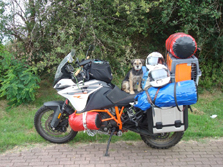
    Home leave. With the fully loaded Doppelhammer we travelled back to our home country again after a long time. Visits to the family and to friends and a few trips to the authorities were dealt with during that time. We found it very hard to find our way around in the everyday life of the Germans again. Even on the motorways at home every centimetre of progress was fought for with no holds barred. Traffic jams kilometres long became a challenge even on the motorcycle, one I had to get used to again. Because in other countries a motorcyclist is given a bit of help when he filters past, because of the heat that builds up in his gear and the engine idling. Here, though, we were more often stopped from getting past by vehicles pulling across. For our passenger too, the border terrier in his transport box between the steaming cars, it was no easy task. I also noticed that you have to drive through an unbelievable forest of signs if you want to reach your destination. At times I could count between 15 and 20 of them per kilometre. That would mean that there is a sign about every 50 metres. The same exercise in France came to about 5 to 10 signs per kilometre. Why there are so many in Germany and so few in France I could not find out during this short stay. Two weeks were more than enough for us, who live freely in nature, to realise once again that the way of life we chose almost 20 years ago was still the right one. At the moment I am repairing ships again, so that others can pursue their hobby without worries and enjoy their few days of holiday. Many thanks to everyone who made our home leave easier.

    Paul’s motorcycle
    • Position: 47° 12.896 N 005° 23.665´ E
    • Wind: calm
    • Weather: sunny / 28.2 °C
    • Water temperature: Water: 24.0 °C

    This married couple are on their way from the UK to the Mediterranean with their sailing boat. At one of the many locks they tore a stanchion base out of the hull with their line. During a short stop alongside my starboard side I was able to repair the damage quickly and reliably from my lower-lying FB5. We wish them a good voyage onwards and fair wind.

    Boat
    • Position: 47° 12.898 N 005° 23.665´ E
    • Wind: SW / 1-2 Bft
    • Weather: sunny / 38.5 °C
    • Water temperature: Water: 24.0 °C

    A few days ago a somewhat larger fish took my hook. A wels catfish 1.70 metres long and with an estimated weight of over 40 kg. Normally we use every fish I catch, but this one is definitely too big for our freezer. With a photo to remember him by, I left him back in his element.

    Wels catfish
    Wels catfish
    • Position: 47° 06.325 N 005° 15.362´ E
    • Wind: S / 1-2 Bft
    • Weather: sunny / 35.5 °C
    • Water temperature: Water: 22.0 °C

    Unscheduled dry dock stay. The gearbox of my bow thruster made itself noticed with loud metallic noises when in use. After a thorough inspection, under water as well, the decision was: no longer repairable, has to be replaced. With all those voyages in the Arctic it has probably done its duty after 16 years of use. It also took a blow last winter in one of the many locks from an object that was sucked in, which tore off all the blades of the propeller at once. Because of the crane work and the lack of space in the high season, the ship could only stand ashore for barely two hours. Replacing the gearbox, cleaning the anodes and painting over damage to the antifouling caused by the ice passages last winter all had to be done in that time. There was even time for a snack.

    Gypsy Life
    • Position: 46° 53.552 N 005° 03.742´ E
    • Wind: calm
    • Weather: sunny / 37.5 °C
    • Water temperature: Water: 24.0 °C

    From the coordinates you can see that we are heading north again. At the moment we are lying at a place we know, out of reach of the commercial vessels. Deep water and many trees and bushes line this tributary of the Saône. The heat has driven us into the shade like this. The previous harbour was like a cauldron, where the temperatures did not drop below 30° even at night. At the moment I am still experimenting with some shading for the ship that actually works, in case there are no trees and bushes along the water’s edge.

    • Position: 46° 16.731 N 004° 43.312´ E
    • Wind: calm
    • Weather: sunny / 34.8 °C
    • Water temperature: Water: 28.5 °C

    Voyage stopped until further notice: because of the increasing heat over the past week, which is supposed to carry on like this, we have stopped our voyage. It is not easy to find a place to lie still here on the Saône, which is heavily used by commercial shipping. The river as such would be wide enough, so there would be room to stay outside the fairway. But unfortunately the consideration shown is less than zero, even though the law requires vessels to slow down for those lying still because of the suction and wash they cause! The passenger vessels in particular, which are also under way at night, do not obey the law. The wave they make is not the problem, but the uncanny suction of these 110 m long ships. They pull the water away from you so far that it tears out both of my widely laid anchors, the ship touches the bottom and heels over onto its side. The danger to crew and equipment is too great. At the moment we are lying in the bushes on the bank of a commercial shipping harbour; here it is very deep and the traffic slows down because vessels have to come alongside and cast off. It is about another 300 nm to the sea. But the temperatures there at the moment are around 40° to 45°.

    • Position: 46° 43.334 N 004° 54.614´ E
    • Wind: S / 1-2 Bft
    • Weather: sunny / 37.7 °C
    • Water temperature: Water: 21.0 °C

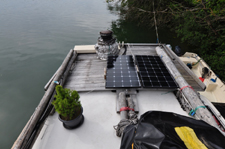
    At the moment I am glad about the high outside temperatures, even if they are supposed to rise to almost 40° next week, as forecast. The high temperatures as such are bearable for us as long as there is wind. When it is calm the temperatures inside the ship shoot up well over 40° in no time. A heat that is too high for the whole crew, the canary Admirali, Walter and us. We are working on the system, the photovoltaic installation and the use of fans in the ship. These fans, spread out at various positions in the ship, provide the wind we want, but they need power. I am trying to produce that with the installation we bought some time ago, so that the cycle closes without fossil energy. It looks quite good at the moment, as long as the photovoltaic installation does not lose even more output through the heat. Because in the Mediterranean the production of drinking water comes on top of that. So we have to be able to live self-sufficiently, so that the steep harbour fees do not kill us.

    Solar
    • Position: 46° 53.516 N 005° 03.745´ E
    • Wind: SW / 4-5 Bft
    • Weather: rainy / 16.8 °C
    • Water temperature: Water: 16.0 °C

    Service extended: that I work on boats and other equipment from my workshop ramp boat (WRB9), newly built in 2018, is well known and has already proved itself quite well in practice. On top of that, I can reach and carry out repairs further away from our fleet with my travel Enduro. As I am in Europe at the moment, the telephone service has settled in well. This option is gladly used for small problems that are not worth travelling to. You call me on 0151/ 15 84 33 37, describe the problem, or send a picture via WhatsApp so that I can judge it better. Over the telephone we then try to take on the challenge together with the owner. That way the skipper is helped quickly and cheaply. I also stand by ships on long journeys with advice and practical help. They draw on my more than 20 years of experience at sea and as a mechanic, in which I have run almost 20,000 operating hours together with my wife. At present a boat is being accompanied from Germany across the Mediterranean all the way to Croatia. Questions about the weather as well as many new challenges that come up every day can be discussed and dealt with quickly this way. For travellers who lack the experience, a welcome option that brings more safety.

    • Position: 47° 06.052 N 005° 15.936´ E
    • Wind: SW / 4-5 Bft
    • Weather: sunny / 31.5 °C
    • Water temperature: Water: 17.0 °C

    Old codger, but not a rusty one: I am trying to make friends with the climate of the south by gradually doing my training in direct sunshine and the heat that goes with it. The press-ups are meant to simulate for the body a fall to the ground with the motorcycle, so that the pulse of loading and unloading, which is stimulated by this kind of terrain anyway, is better trained.

    Harald Paul
    • Position: 47° 12.933 N 005° 23.525´ E
    • Wind: SW / 1-2 Bft
    • Weather: sunny / 24.5 °C
    • Water temperature: Water: 16.0 °C

    The Pauls really should have been in the Mediterranean long ago, because the distance of about 300 nm is no longer a real distance for the two of them. I have to admit they are right, if there were not always a “but”. Our tanks have run empty over the winter. Without diesel there is no onward passage. So I am glad of every repair job I am given from the WRB9. In this case it was a Swiss couple who called on my services for two days. Excessive oil loss from the engine, reduced water flow to the main engine caused by too many filters in line and the use of the wrong hoses, the mounting of the battery bank and many more small jobs made the days crawling around in the engine room pass quickly. Another ship has signed up as well, which needs a service on the main engine and the generator. “But” then the urge to move on takes hold of me.

    Gypsy Life
    Battery
    • Position: 47° 17.036 N 005° 24.613´ E
    • Wind: calm
    • Weather: sunny / 7.8 °C
    • Water temperature: Water: 11.5 °C

    Rhine Adventure: with around 800 hp of engine power, 12 metres in length and about 4 metres in beam, we went up the Rhine. An acquaintance who had bought the ship there wanted to take a spin with us. We accepted his invitation, reached the place in question with our Doppelhammer and promptly loaded the travel Enduro onto the bathing platform. The idea was to have me go over the new ship so as to get a precise picture of the machinery. So the owner went upstream at a brisk pace and I crawled through the engine room and inspected all the machinery. I had just come up for fresh air outside when there was a hefty bang at the propellers. The ship had been steered over the end of a groyne at a fair speed. One engine failed completely because the rubber coupling disc was destroyed. The other could only be run at idle speed, because its propeller was badly damaged as well. I immediately brought the ship out of the danger area and steered it through the strong Rhine current to the nearest harbour. A first damage assessment showed no water ingress, which eased the situation noticeably. The following day I took the ship about 20 km downstream to another harbour that had a lifting facility. The people based there told us that we are the fourth to have run aground in that spot. Only a faint consolation for the owner.

    The Pauls
    • Position: 47° 13.910 N 005° 23.871´ E
    • Wind: calm
    • Weather: sunny / 7.8 °C
    • Water temperature: Water: 11.5 °C

    As you can see from the coordinates, Gypsy Life’s position has not changed. We feel at home in the sea of stinging nettles and are watching the birds around us building their nests and nest holes. Many animals accept us as fellow residents and are steadily losing their shyness, walking past our fleet at night to within a few metres. The longer stay is also bringing us a growing reputation, which among other things benefits my repair service. An Australian had the hinges on his stern window rusted solid, so that it could no longer be opened. I promptly cut them off with the angle grinder and replaced them with new ones, which I screwed on. Delighted that he can open it in the heat that is to be expected, he gave me an original Australian straw hat.

    The Pauls
    • Position: 47° 13.909´ N 005° 23.868´ E
    • Wind: SE / 2-3 Bft
    • Weather: sunny / 23.3 °C
    • Water temperature: Water: 11.0 °C

    Our position is level with Auxonne. We are lying here in a side arm of the Saône. The bank is lined with bushes and old trees. The ground is a sea of stinging nettles, which flower together with other small flowers and are visited by countless insects such as bumblebees, bees, hoverflies, wasps and hornets and so on. Everything hums around us, so that we are cut off from the outside world acoustically. We lie here as if in a nature park. Every evening I can spot 5 roe deer in the immediate vicinity. Two badgers and several foxes search the meadow for mice. At night I have also been able to make out 2 wolves with my thermal imaging camera. At the moment I am doing the jobs that come up in our ships. I want to have everything done before the heatwave if at all possible. Paint work in particular is important now, because otherwise in the great heat it dries too quickly and gives off fumes accordingly. The new report No. 25 “Lidl, Water, Electricity” is finished and describes how you can fare over a winter in France. I also devote many pictures, with the text to go with them, to France’s extremely strong forestry industry, and I ask a trained forester I met on the spot how our forests are doing after the forest dieback predicted years ago. I wish you all a good start to the new season, and may your plans come to fruition.

    Gypsy Life
    • Position: 47° 12.933´ N 005° 23.525´ E
    • Wind: calm
    • Weather: partly cloudy / 7.5 °C
    • Water temperature: Water: 7.0 °C

    The Saône still has us firmly in its grip. Because of the continuous rainfall the water level has risen considerably. A fair amount of driftwood, such as logs, whole trees and other things, is being washed down towards the Mediterranean. It would have meant slow going for us as well. In the spring, when I bought the new vignette in Nancy, I had all the canal closures handed to me in writing straight away. I did not want to have to put up with waiting times that were too long, as I did last year. But now we are stuck again. Some locks along the onward route have been closed outside the schedule. Why and for how long was answered with a shrug of the shoulders from the VNF employee. That is simply how France is, very relaxed.

    Gypsy Life
    • Position: 47° 12.933´ N 005° 23.525´ E
    • Wind: SW / 4-5 Bft
    • Weather: cloudy / 12.5 °C
    • Water temperature: Water: 5.0 °C

    Wild boar attack successfully fought off: our ships are lying not all that far from the town of Auxonne. I went on the evening walk with Walter, our border terrier. The dog, a little ahead of me, turns off to the right behind a small strip of woodland, under a barbed wire fence and into a meadow. When I reach the same corner, I see the dog running along the bushes about 50 m away from me. Suddenly he stops and I see half of his body disappear into the bushes. Suddenly the dog screams pitifully and does not stop at all. I have never heard a dog scream like that. With my wits about me I climb over the five-strand barbed wire fence and run to the place where I think he is. On every trip ashore I always carry a stick 84 cm long with me. It is exactly as long as my handlebars are wide and as thick as the grips of my two Enduros, and I use it for forearm training. With this stick I broke through the thorn-covered scrub to my dog and beat hard blows down onto a mud-covered brown and black bristly coat in front of me. While doing this I could not make out the size of the animal. The smell, and the grunting after the dog had stopped screaming, told me that it was a wild boar. I did not see my dog straight away and heard nothing either, only the cracking of the branches through which the wild boar was fleeing. Shortly afterwards I saw Walter crouching in the bushes some distance away, without his red and white hunting collar. I called him to me, because the merciless thorn scrub made it impossible for me to get to him. A first examination on the spot showed no injuries on the dog. All that could be seen was a white strip along his neck where the fur is missing. I found his collar torn apart a few metres away from us. As if by a miracle, the dog came through the wild boar's attack without any major injuries. I suspect that the collar acted as protection. It is only in my own case that over the next few days I will have to remove, with a magnifying glass, the countless thorns of roses, brambles, hawthorn etc. from my legs, kneecaps, forearms and hands.

    Pig
    • Position: 47° 17.036´ N 005° 24.613´ E
    • Wind: SW / 1-2 Bft
    • Weather: sunny / 15.5 °C
    • Water temperature: Water: 4.0 °C

    Warning, danger to life:
    The use of “Silentwind” wind generators is life-threatening:
    On my expeditions lasting several years I depended on alternative energy. “Silentwind” assured me that they were the right partners for that...........as their wind generator withstands even the heaviest winds.
    In the autumn of 2013 we only just prevented a fire on the ship. The cause was the charge controller from “Silentwind”. It could not brake enough against the winds we had. So the “Silentwind” wind generator was permanently charging the batteries at full power. Cables and batteries became so hot that they could no longer be touched. Smoke and a foul stench went with this dangerous situation. Furthermore, gusts of wind loosened the blade cover cap, which then damaged the blades. In this emergency the only thing left was to chop the cables off the generator.
    2016 After the “Silentwind” company assured us that the new charge controller and also the revised “Silentwind” wind generator really would withstand anything, we bought a new one.
    A situation with danger to life: the charge controller withstood the prevailing winds, but the “Silentwind” wind generator did not. It ran at full speed despite the brake being switched on. The “Silentwind” wind generator ran at such an extremely high speed that the blade cover cap came loose again and damaged the blades. In this situation it was not possible for us to intervene. We stayed awake all night so that we could react immediately to a possible fire or damage. The noise level caused by the unbraked wind generator was comparable to a helicopter landing on our ship's superstructure, all night long. A later analysis of the “Silentwind” generator showed the following: the magnets in the generator had come away from the armature in an inexplicable way and had completely burnt out and destroyed the inside of the generator. If the wind had kept on, the housing would have burst because of the parts whirling around inside it (comparable to stones in a gearbox). With that force, parts could have caused devastating harm to the crew and to uninvolved people, like projectiles, as well as considerable damage to property. Conclusion: we will never fit such a “Silentwind” wind generator again, because both “Silentwind” wind generators were life-threatening for the crew and for uninvolved people through flying parts. We cannot take on that responsibility; the danger to life and limb is too high. Anyone who would like more information can contact me at any time at harald-paul@haraldpaul.com .

    Small part1
    a Generator
    b Generator
    • Position: 47° 17.036´ N 005° 24.613´ E
    • Wind: NE / 1-2 Bft
    • Weather: sunny / 15.5 °C
    • Water temperature: Water: 4.0 °C

    Today Paul was out on the sports enduro hunting for pictures again, for the first time in a long while. With its bright sunshine, the weather was a real invitation to do so. The readers of the reports know my photos, which show a lot of nature and record the things I write about in my texts. Research on the spot reflects reality best. So today I travelled a long way for you, to gather as much material as possible. Today I also met a hunter who had been watching me for a while. When I saw him, I stopped. He had noticed that I always rode only along the edges of the fields or the rows of bushes and not straight across the farmland. It was not the rule, he said, that motorcycles were simply allowed to tear across the fields, and certainly not during the hunting season. But I had not done that, was his observation. With my few scraps of French I made it clear to him that, as a farmer and forester myself, I have green fingers and want to cause as little damage as possible. And that I also report on the natural conditions in France, and that the bike is indispensable for the long distances. He had never heard or seen anything like it. The hunter was taken with my nature photos, which I was able to show him on the display of my camera. The motorcycle, painted in the French national colours, also aroused his interest. Two-stroke with electronic petrol injection and load-dependent, computer-controlled mixture preparation practically knocked him off his feet.

    Harald Paul
    • Position: 47° 54.428´ N 005° 59.945´ E
    • Wind: SW / 1-2 Bft
    • Weather: rainy / 4.8 °C
    • Water temperature: Water: 3.0 °C

    For a few days now our fleet has been afloat on the river Saône. Rain, snow and ice have not stopped us from carrying on southwards. But compared with others we are travelling much more slowly. “We live of the land”, a way of life we have been practising for almost 20 years. Even here in civilisation, that includes getting drinking water. In most harbours no water is available over the winter. You can lie there, you also get electricity, you pay the full price, but usually no water. As we are under way without harbour supplies anyway, it does not hit us the way it hits some others. On my sports enduro I search along the canals or rivers for streams. Finding an inflow with good water quality here is very difficult. If the indicators do not tell me enough, I have to follow the watercourse as far as its source if possible, which is not always easy in the hilly landscape with all its fences and other barriers. We also constantly need wood, and as dry as possible. One of the hardest tasks in the permanent wet we have. Here we look for fallen dry trees without bark. The best ones are trees that our friend the beaver felled years ago. These have mostly had their branches and bark removed already (food for the woodcutter) and so find their way into our stove more easily.

    Gypsy Life
    • Position: 48° 01.395´ N 006° 14.881´ E
    • Wind: calm
    • Weather: partly cloudy / 5.8 °C
    • Water temperature: Water: 3.0 °C

    In the winter of 2009/2010, during our first overwintering in Canada, I had to spend several hours under water at a water temperature of 2° doing some work on the ship. My whole body was so chilled that back then I needed a full day to bring myself up to working temperature again. Today I had to go down again, because some object had jammed in the bow thruster, which tore all the blades off the propeller. Normally the replacement is done in a few minutes, even under water. But here in the canal the water was so murky that I could see nothing. Even when I was right up close to the bow propeller with my mask, I could not make out the screws that had to be undone. Everything had to be felt out with the thick gloves, which turned out to be extremely difficult. In the end, after a good hour's work, I could be sure that the new propeller was securely fitted. The test afterwards confirmed that for me as well. As the outside temperature was not in the double-digit minus range as it was in Canada, I did not need any warming-up phase after the dive.

    • Position: 48° 09.963´ N 006° 18.208´ E
    • Wind: N / 2-3 Bft
    • Weather: cloudy / 4.8 °C
    • Water temperature: Water: 4.5 °C

    Visitors from Austria. A married couple we know from Austria announced their visit by email. They were on their way south just as we are and would drop in briefly with their motorhome. It was not long before the camper came rolling across the meadow to the quay at Girancourt. A nice afternoon and the evening that went with it were the result. We were given a lot of tips regarding the Mediterranean, as the two of them were under way down there for many years. The steep harbour fees down there were a particular topic. How do we intend to handle that with our fleet? It all depends on how seaworthy the combination is and how well we manage with it on the open sea. We shall have to wait and see.

    Gypsy Life
    • Position: 48° 11.605´ N 006° 25.104´ E
    • Wind: calm
    • Weather: dark / 3.3 °C
    • Water temperature: Water: 4.0 °C

    Enough water: contrary to expectations, the rain over the past weeks has raised the water level in the whole of the Canal des Vosges, so that it is now completely navigable. The coordinates show that we are lying at the end of Epinal, in front of the last locks of the town. Despite fog, chilly temperatures and thin ice on the surface of the water, we managed to pass through 21 locks in one day. Snowfalls and falling temperatures in the coming days will hopefully not slow down our onward passage southwards. What is more, there is talk once again of canal closures because of repair work. Let us see how things go on.

    Gypsy Life
    • Position: 48° 40.653´ N 005° 53.077´ E
    • Wind: SW / 3-4 Bft
    • Weather: Rain / 12.5 °C
    • Water temperature: Water: 5.0 °C

    As every year, at the end of the year I want to send a few lines to my loyal readers and to the new readers of this logbook “Heat Instead of Ice”. With the 650 nautical miles we covered this year we are not going to win any medal. Two or three years ago, on the expedition “Danube – Alaska”, such short distances were knocked off in four days’ runs (a day’s run = 24 hrs non-stop travel), and at the end of the year the log showed over 10,000 nautical miles covered. I do admit that this year at least we have become soft adventurers. But I have to say honestly, it did us good to be able to lie still for longer, without having to keep an eye on the tide, hurricane-force winds, ice and Mr Bear. Especially with regard to the new lighter WRB9, which I have gone on fitting out into a complete workshop, the time and above all the weather did a lot of good. Because of the longer times lying still and the shorter distance to Germany, family contacts have been firmed up again, so that this year we rode over 20,000 km on the adventure bike, the Doppelhammer. And the nice thing on top of that, we did not get wet for a single kilometre of it. The attentive reader of this entry will surely not have missed the fact that the coordinates have changed. Quite right, we can carry on further south. The rain of the last few weeks is showing its effect. At the moment I am still repairing a ship from my workshop boat, the WRB9, a ship which is also on its way south. So we would like to thank all the readers of our website and of the reports, the subscribers to the reports and the many ship owners who have made use of our unique, newly created repair service from the water. We wish you all a happy Christmas and a good start to the new year.

    • Position: 48° 42.212´ N 005° 43.231´ E
    • Wind: SW / 3-4 Bft
    • Weather: Rain / 8.5 °C
    • Water temperature: Water: 8.0 °C

    Christmas is just around the corner and some of you are still looking for a special present? Perhaps something from my range of DVDs, books or my reports would be suitable. Taken together in chronological order, these items show our adventurous life in absolute freedom. Free from any pressure, only in harmony with nature, fighting for our daily bread. That was the idea a good 20 years ago when we changed our way of life. Spitsbergen, Scandinavia, Iceland, Greenland, Canada and now on the way to the Mediterranean are the places we have stayed, all of them reached with our own ship. Just let yourself be carried along and dive into a completely new life. I guarantee that we lived through, filmed, wrote down and photographed everything ourselves, without a team to help or protect us. Something like that has to be seen and lived through once. How to obtain the items and reports is listed on this website under the heading Sales. DVDs and books can be ordered quickly and easily over the internet from the specialist dealer linked here. The “Paul’s Reports” are available from me personally by
    email harald-paul@haraldpaul.com as a PDF, and singly or all together they make up a work in text and photos which shows the reality of nature and of a life lived in it. Happy choosing.

    • Position: 48° 42.212´ N 005° 43.231´ E
    • Wind: calm
    • Weather: cloudy / 13.8 °C
    • Water temperature: Water: 8.0 °C

    Basis of life destroyed: When I looked into the water around my ships this morning, I could not believe my eyes. The water had changed from crystal clear, so that I could always see the bottom, to a dark brown, almost black colour. I set off straight away with my FB5 to locate the source. Unfortunately without success, although the brown broth could only be seen near us. About 300 m further north or south the water was still clear, but it was colouring up more and more. The taste test was bitter. I heated the water in a bucket with an immersion heater and here too I could detect a strong smell. My suspicion is water which stood somewhere for a long time and was full of oak leaves. It got into the canal in a way I cannot trace. I do not assume it is poisonous, because I have not found any dead fish either, but for normal use (washing water and water for personal hygiene) and for drinking it is certainly no longer suitable. As a result a very important branch of our supply is gone at a stroke. Because I acted quickly I still managed to fill my four water barrels with the normal canal water far enough away and to bring them to the ships. So for about two weeks we are not dependent on the canal water. Time enough to react to the new situation.

    brown water
    • Position: 48° 42.212´ N 005° 43.233´ E
    • Wind: calm
    • Weather: dark / 5.8 °C
    • Water temperature: Water: 8.0 °C

    Voracious neighbours: In the German media you hear complaints about the growing wolf population and the helplessness that comes with it. We, for our part, face the challenge of coping with countless mice in our immediate neighbourhood. The biggest problem is my motorcycle, parked on the other side of the canal. Here the little rodents have got in as far as under the seat and have gnawed through my tool bags and the cleaning rags that go with them. Furthermore they have built a nest between the cylinders of the V engine and made themselves at home. It is all still bearable, as long as they do not “get their teeth into” the wiring or even the electronics. To be on the safe side I had to load the motorcycle into my workshop boat WRB9 and completely dismantle it there for checking. Several days of work were needed to check everything conscientiously. No damage so far. For the future I shall have to find an arrangement between the rodents and me.

    • Position: 48° 42.210´ N 005° 43.230´ E
    • Wind: calm
    • Weather: dark / 7.8 °C
    • Water temperature: Water: 8.5 °C

    Today we spoke to the canal authority once more about how we can get on from here. On the canal le canal des Vosges four locks are passable again from this week. And only because a private contractor is extracting sand from the Moselle and has to transport it through the first four locks of the canal system. But four chambers would not be much help with 93 locks to be worked through. So we are forced to set ourselves up a little better for the coming winter. First priority is getting firewood and transporting it to the base. I work up small fallen trees, as these have dried best over time. The single-axle tractor takes care of the transport. By arrangement we can also buy dry firewood and have it delivered. So this supply is secure for the time being. The drinking water at the jetty about 2 km away has been turned off because of the risk of frost. Later on we will depend here on the canal water, which has to be filtered well. With the motorcycle the supply of all other materials is also taken care of. So we can go into the winter with a clear conscience. In spite of civilisation being close by there is plenty of game around us, fox, badger, roe deer and wild boar, and we have even sighted a wolf. A little Canada!!

    Harald Paul
    • Position: 48° 42.210´ N 005° 43.230´ E
    • Wind: NW / 2-3 Bft
    • Weather: sunny / 4.7 °C
    • Water temperature: Water: 08.0 °C

    Report 24 “Accurate to the Centimetre” is finished. It describes how we managed to get into the French Meuse with our ships despite a draught limit of 1.60 m. The shift supervisors at the first French lock had not let Gypsy Life enter with her 1.80 m draught. We had to turn round. It also describes how we came closer to the country and its people, although we do not speak a word of French. How we got on with our tow on the canals and further small adventures. As usual plenty of photos, so that you get a better idea. As you know, orders can be placed with me personally by email. Even if this way of ordering is a little old-fashioned, it does make it possible to answer many of the readers’ questions. That way you have closer contact with one another. Many nice personal meetings have come about through it too.
    Happy reading.
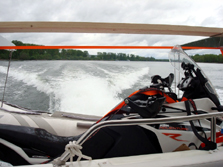
    Gypsy Life
    • Position: 48° 42.212´ N 005° 43.231´ E
    • Wind: SW / 1-2 Bft
    • Weather: Rain / 12.0 °C
    • Water temperature: Water: 08.0 °C

    A reminder of old times: Restoring and repairing this Agria single-axle tractor (built 1977) on the WRB9 reminded me again of the days of my landscape management and forest reclamation work. A machine like that was in use with me every day, mostly for over 10 hours a day. As it was a single-axle tractor and not a four-wheeled vehicle, whatever the job, you had to walk along beside it. That added up to quite a few kilometres a day. You kept moving. It is understandable that the present rain hardly shows in the water level in a canal system with no further inflow. But now the canal authority has become active and, after several phone calls on my part, is currently pumping water very slowly into the system. Centimetre by centimetre the water level is rising, so that the water-cooled engines (main engine and generator) can be put back into operation. Normal life on board is returning. But there is still no thought of carrying on south.

    • Position: 48° 42.212´ N 005° 43.231´ E
    • Wind: NW / 2 Bft
    • Weather: Rain / 5.8 °C
    • Water temperature: Water: 15.0 °C

    The water level is falling continuously, as if someone were letting the canal run empty. It was the leaves drifting past on the surface that gave me that idea. Especially as there really is less and less water in the canal. Our Gypsy Life has already been sitting on the bottom for a few days. But with the water disappearing the ship has no support at the sides and is beginning to lean over to one side. After I contacted the canal supervision, they came by in person to discuss the situation on the spot. The pump which pumps water from the Moselle into the canal over about 1 km of pipe and 50 m of height difference has been standing still for about a week. A pipe is said to have been damaged during excavation work. Repair in prospect. Good information, but not satisfying. Because that would not make the water any less. Somebody is sucking the canal empty. They spoke of leaks in the canal which would make the water level fall. As it is raining at the moment, that ought to more or less cancel out. But it does not. Today the boss came by in person and explained to me that water is needed for the Meuse and that it is being taken from this canal. They want enough water in the river for the fish. I made it clear that we had been ordered out of the river Meuse into the canal system especially because of the risk of flooding. I have politely handed responsibility for our ships over to the canal authority. In the meantime the ship has been secured sideways to trees and to the sheet piling with low-stretch rope to stop it toppling over. It is exciting. So the onward passage south remains a dream.
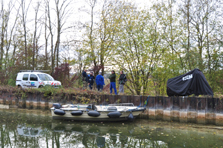
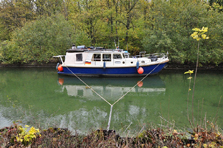
    Gypsy Life
    Gypsy Life
    • Position: 48° 42.210´ N 005° 43.230´ E
    • Wind: calm
    • Weather: dark / 15.5 °C
    • Water temperature: Water: 17.0 °C

    Last autumn I wrote under News that cranes flying over me stirred a restlessness in me and that I then left Finland on the spur of the moment and carried on south. Lately, here too, especially at night, I see many cranes flying over us on their way further south. It is pure chance that we are lying exactly in their flight path and so have the chance to watch them. I feel nothing of that restlessness, although at the moment we are sitting on the bottom here with Gypsy Life because of the lack of water. Supplies are assured by our adventure bike and by the fishing boat FB5, which can still be used even at a very low water level. Firewood is being cut and split at the moment so that the ship can be dried out from the inside during the rainy months. Whether this is already our wintering place I cannot say yet.

    Harald Paul
    • Position: 48° 42.212´ N 005° 43.233´ E
    • Wind: calm
    • Weather: dark / 16.1 °C
    • Water temperature: Water: 15.0 °C

    Don’t they say you always meet twice in life? In 2014 we got to know a couple from the Black Forest in Isafjördur and had a good time together. Now, 4 years on, the couple has visited us again here near Pagny sur Meuse. A barbecue on the WRB9, coffee and cake on the Gypsy Life, and all that in the best of weather. That is hopefully how our guests will remember us. It was a good time again. Thank you.

    Gypsy Life
    • Position: 48° 49.971´ N 005° 30.654´ E
    • Wind: calm
    • Weather: Cloudy / 9.8 °C
    • Water temperature: Water: 16.5 °C

    Setting off: Quite unexpectedly we get word from the VNF (the organisation in charge of the French canals) that we can carry on. There is one small catch, though. Only a window of a few days is available. The organisation wants all the ships lying in the Meuse out of there. They are afraid there could be problems with the annual high water in the winter months. That is why they want all the ships in the canal system above Toul, because the high water is regulated there. The window is not workable for us on a stretch with countless locks. So the VNF decides that the lock times have to be extended for us as professional boatmen. Instead of 09:00 – 18:00 it is now 07:00 - 19:00. But at this time of year, when it is still quite dark in the morning, that calls for safe manoeuvring in darkness. The ship should have not only radar but also a suitable set of floodlights covering every side. Because the locks and tunnel entrances, with their narrow approaches, are considerably darker than the surroundings. Our Vlet, currently used as the towing vessel, has enough light sources thanks to years of navigating in the winter months in the Arctic. So it is possible for me to make headway safely even with the lighter WRB9 and the fishing boat FB5 in tow, a length of about 28 m. But the onward passage is limited as well. At Toul, at the end of the Meuse canal, a bridge construction site is still not finished. The aim is to be done with the work by 28 October 2018. Anyone who has dealt with the water for a long time knows that there are always unforeseeable challenges. However it turns out, we have in any case come a little closer to the south.

    Gypsy Life
    • Position: 49° 24.091´ N 005° 11.207´ E
    • Wind: calm
    • Weather: Cloudy / 22.8 °C
    • Water temperature: Water: 20.0 °C

    A week of home leave with 1800 km ridden on our Adventure Enduro has been completed. The best weather, no rain. Fine for riding the motorcycle but rather bad for the onward passage southwards. According to the latest reports, on top of the missing water there is now also a repair on two locks. I suspect they want to use the low water to do the work. So my hope of possibly getting on in mid-October is destroyed. According to official information the work is to be finished by 18 November 2018. If you know the calm and stress-free mentality of the French, you may as well add a few days to that before things really move on. If you believe some people’s fantasies, the repairs are supposed to last over a year. We take it calmly, because on the nearest canal that would allow a way round, a small building was blown into a lock by a strong wind. There the salvage and the repair of the damage really are said to take over a year. We will carry on developing our berth on the canal bank, lined with bushes and trees, just as we know it from the winterings in the Arctic.

    • Position: 49° 24.091´ N 005° 11.207´ E
    • Wind: SW / 1-2 Bft
    • Weather: sunny / 24.8 °C
    • Water temperature: Water: 21.0 °C

    Time flies: We are lying far from any harbour supplies, as already mentioned as “shade parkers” under trees, and do not even notice how fast the time goes by. Every day is full of work keeping the three ships and nine engines in good condition. Servicing, maintenance, repair and painting work keep us quite busy alongside the everyday recurring jobs. The rain, and with it the filling of the canals and rivers that we would expect, is still not coming. We are currently developing our berth further, because I assume that nothing will move before the end of October.
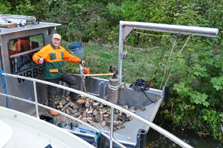
    Harald Paul
    • Position: 49° 29.099´ N 005° 12.049´ E
    • Wind: 0 Bft
    • Weather: sunny / 33.7 °C
    • Water temperature: Water: 26.0 °C

    The dream is over, nothing is moving any more: We are lying just short of Verdun, a town that many historians will know. According to the lock keepers the water level from St-Mihiel on is so low that shipping has been suspended. Up to there a few more river kilometres would still be navigable for us, but apparently, because of the closure, the harbours and free berths are overloaded with waiting ships. With the persistent temperatures well over 30°, though, we prefer to be able to go by where there is shade. Many ships that passed us are coming back towards us on a reverse course, heading north. Now we have to wait for continuous rain to set in so that the rivers running to the Meuse carry water again and can fill it up. According to the weather forecast, 0.9 L/m² of rain is due over two days in the next 14 days. With such a minimal supply of water it can take weeks or even months before the closure is lifted. When I think back to the expedition “Danube – Alaska” in 2013, we waited 11 months in Iceland until the frequency of hurricane-force winds eased and the pack ice showed such gaps that a small channel became visible for us. Unless unforeseeable obstacles from the authorities or anything else build up in front of us, we will wait.

    Walter
    • Position: 49° 29.485´ N 005° 10.823´ E
    • Wind: S / 1-2 Bft
    • Weather: sunny / 41.1 °C
    • Water temperature: Water: 25.0 °C

    That temperatures differ from place to place is something I documented on my Arctic voyages, and I have to note the same thing here in these latitudes. At the moment we are lying fairly out in the open, so that a light wind can reach us, and yet the temperatures are over 40°. Near woodland or bushes the temperatures are around 35°. Under these circumstances, to transfer a temperature rise of 1° - 1.5° over the year to a large area (the globe) is for me more than a naive claim. The values over the land masses and the water masses turn out far too differently. Especially as there is not even the beginning of full coverage by measuring stations on the water. The water masses, after all, make up 2/3 of the earth’s surface. Taking the winterings in the Arctic as a basis, the material and the crew are coming through a temperature difference of more than 80 °. This process can only happen step by step, which is why I mentioned before we set out on our voyage that we would be travelling slowly.

    Snow
    Cold
    • Position: 49° 47.606´ N 004° 45.523´ E
    • Wind: calm
    • Weather: sunny / 38.5 °C
    • Water temperature: Water: 24.0 °C

    Report 23 “Towards the Sun” completed. Many readers know my reports from the previous expeditions. In them, among other things and wherever possible with photos as evidence, many matters that the media documented incompletely on the subject of the Arctic were shown in a different light. After almost 20 years of travelling there, several winterings on the spot on our own ship, and most recently a continuous stay of 4 years, we have set the subject of the Arctic aside for the coming years and are, as is known, heading south. The present reports are a summary of some interesting facts and of the course of the journey as such. Which people we got to know and which situations had to be mastered. The photos show the landscape from the waterway by ship and from the remote tracks by motorcycle. So just the thing after a stressful day, to take your mind off things with photos and text. To read something positive for once and look at something nice and leave everyday life behind for a while. How you get hold of such a report is arranged very simply by me. The information is under the heading Sales. You write an email harald-paul@haraldpaul.com, or get in touch with me via Facebook.

    Sun
    • Position: 49° 54.213´ N 004° 41.136´ E
    • Wind: SW / 2 Bft
    • Weather: cloudy / 17.5 °C
    • Water temperature: Water: 24.0 °C

    Entered France and straight away made our first acquaintance with a like-minded person. Thanks to a few measures regarding the draught of our Gypsy Life, we were able to enter the “Canal de la Meuse” after all. The plan of going by roundabout ways through France’s numerous canals in order to reach the Mediterranean was quickly dropped. There too, various obstacles from defective locks and the very low water level caused by the persistent drought are the order of the day. We are travelling slowly and waiting until it rains in the higher ground so that the water level in the canal rises a little again. At the moment we still have no difficulties with regard to the depth of our ship. But we have already met a sailing boat that turned back with a draught of 1.80 m. For us, though, it is a southerly course again for now.

    Harald Paul
    • Position: 50° 09.785´ N 004° 49.095´ E
    • Wind: NW / 2-3 Bft
    • Weather: sunny / 27.2 °C
    • Water temperature: Water: 21.0 °C

    A few days ago, after visiting the Linssen yard in Holland, we had crossed the Belgian border without any trouble and were on our way in good spirits towards France, to the “Le Canal de la Meuse”, to the town of Givet to be precise. When we arrived at the first lock, where you also pay the fees for France’s locks, we were politely told that because of a long-standing damage the whole canal with its 272 km and 59 locks now carries only 1.60 m of water instead of 1.80 m. We no longer draw quite as much as 1.80 m, but 1.60 m or rather less is not what we draw either. On top of that, some locks right at the beginning of the canal are out of order at the moment. There is no estimate in France of how long the repair will take. With presence of mind we looked for alternatives, via other canals nearby that have a connection to our route. With a friendly smile we were told that these are not navigable either, as there are locks out of order there as well. There are further possibilities for getting through France, but they are far longer and fitted with considerably more locks, tunnels and boat lifts. Whether we take on this challenge we cannot say at present, as not all the information about navigability is available yet. In any case it is a northerly course for now. We had to turn back.

    • Position: 51° 13.361´ N 005° 59.483´ E
    • Wind: SW / 1 Bft
    • Weather: cloudy / 25.8 °C
    • Water temperature: Water: 21.5 °C

    Our WRB9 has been turned into a barn for the time being. The cows are out in the pasture, but their curiosity drives them over to us. In time they get cheeky and then even want to step into the barge. Not that it would not stand up to that, but if the cow then takes fright there are uncontrolled movements which could cause damage after all. I found the bantam hen in the grass while riding the sport enduro off-road, far from any farm. It was so tame that I could easily pick it up by hand and carry it to the boats in my rucksack. The hen settled into the barge at once and feels at home. In the meantime I have ridden round a few farms to ask who is missing a hen like this. No luck, most farmers no longer keep hens, only intensive livestock farming. All the doors of the boats stand open, but the bantam stays with us and clambers about on all the ships. Walter would love to eat it, so I have to keep an eye out at the moment.
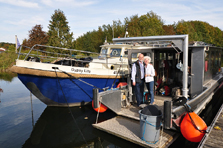
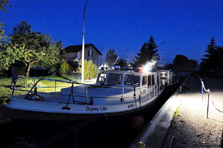
    Cow
    Chicken
    • Position: 51° 48.816´ N 005° 24.613´ E
    • Wind: E / 1 Bft
    • Weather: sunny / 30.7 °C
    • Water temperature: Water: 23.0 °C

    Today of all days has shown us what it means to be properly warm. Even though we shaded the ship’s windows from outside, we reached almost 40° inside. Properly warm even for Kanaria Admirali. The fans are running at full load. With the air conditioning we manage to hold our sleeping cabin at a constant 22°. The outer floor surfaces of the WRB9 heat up so much that they ripple slightly. With Walter I have to take care that he does not burn his feet on the aluminium. I cool the floor down with water before he steps onto it. When I remember my youth in Brazil and how hot it was there, the thermometer can still climb a good deal higher. Heat Instead of Ice is beginning.

    • Position: 51° 44.511´ N 004° 44.492´ E
    • Wind: NE / 3-4 Bft
    • Weather: sunny / 30.0 °C
    • Water temperature: Water: 19.0 °C

    Reached the Biesbosch nature reserve. A huge area of islands and reed beds lying between the rivers Maas and Nieuwe Merwede. We are just now sneaking our way through this partly very shallow area with the three ships. A slight tidal range and no channel markers add to the small challenge of reaching hard-to-access corners with our draught.

    • Position: 52° 11.657´ N 006° 09.652´ E
    • Wind: SW / 5-6 Bft
    • Weather: sunny / 13.2 °C
    • Water temperature: Water: 16.0 °C

    Over the last few days I cannot speak of heat. The temperatures were above 24° for just a few days in the middle of the month. But then it cooled down again to a maximum of about 15°. The nights were well below 10°. If we did not see the green all around us, I could easily think we were back in the north. In any case I had to chop wood for our stove. I used a calm spell to make a quick little dive around the ships despite the somewhat fresher water, so that I could check that everything is in order. Cleaned the anodes and checked the propellers of the drives for foreign objects such as fishing line. At the moment we are fighting our way upstream against the current of the Ijssel. The outboard of the WRB9 is running as well and so helps Gypsy Life bring all the floating units upstream. We are holding a course southwards.

    Harald Paul
    • Position: 53° 05.955´ N 005° 54.202´ E
    • Wind: SW / 3 Bft
    • Weather: sunny / 28.2 °C
    • Water temperature: Water: 16.0 °C

    Goodbye, Drachten in Friesland (Holland). Here we spent a few months over the winter and got everything ready again so that the new challenge “Heat Instead of Ice” can be taken on. Our course is set for South Holland, in order to reach Belgium afterwards by way of the river Maas (upstream). As you can see in the photo, the temperatures are already quite high for us. The light-coloured paint on the ship’s superstructure and the use of the air conditioning have proved their worth. Our daily routine from the north (the Arctic), settled in over twenty years, now still has to be adapted to these temperatures. For the new readers of the logbook, some information in advance. The time is given in utc (coordinated universal time). This is the base time for the whole world. From it you can convert for any place you happen to be, so that you have an exact idea of the time. For Germany, Holland, Belgium etc. add two hours. Through the coordinates, the lines below give the exact position where the ship was at the time stated. The letters and the numbers in the Wind line start with the direction, N for north, S for south, E for east and W for west winds. An SW is therefore a south-westerly wind. The number after it gives the wind force in Beaufort (Bft). A 0 is calm, a 12 is hurricane-force winds. Hurricane-force winds are then divided into five further levels, of which we got plenty of samples in the Arctic, especially during the winterings. But in the latitudes we now want to travel, such hurricane-force winds do not normally occur. As a rough guide I may mention that 5 Bft is about 30 km/h. 10 Bft would therefore be around 100 km/h and is called a strong storm in our latitudes. In the Arctic that comes under a moderate refreshment, and only from this force on do you even begin to speak of wind at all. In this newly opened logbook I will publish information at irregular intervals, so that you as a reader can take part in the journey as you please. We — my wife Silvia, the terrier Walter, the Greenlandic canary Kanari Admirali and my humble self — wish you much enjoyment and good entertainment.

    Departure